뒤로

Lecture Exam 2: Anatomy & Physiology: Nervous System and Brain Function

컨트롤 버튼이 '내비게이션' 모드로 변경되었습니다.
1/24
  • Anatomical divisions of the nervous system

    The nervous system is divided anatomically into the Central Nervous System (CNS) and the Peripheral Nervous System (PNS).
  • Components of the Central Nervous System

    The CNS includes the brain and the spinal cord.
  • Components of the Peripheral Nervous System

    The PNS is made up of nerves that connect the CNS to the rest of the body.
  • Number of cranial and spinal nerve pairs

    There are 12 pairs of cranial nerves and 31 pairs of spinal nerves.
  • Three general functional categories of the nervous system

    • Sensory input: Detect stimuli.
    • Integration: Process and interpret sensory input.
    • Motor output: Respond by activating effectors.
  • Structural classification groups of neurons

    Neurons are classified structurally as multipolar, bipolar, or unipolar based on the number of processes extending from the cell body.
  • Functional classification groups of neurons

    Neurons are functionally classified as sensory (afferent), motor (efferent), or interneurons.
  • Clusters of neuron cell bodies and bundles of axons in CNS

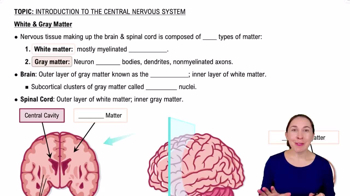
    Nuclei are clusters of neuron cell bodies; tracts are bundles of axons.
  • Clusters of neuron cell bodies and bundles of axons in PNS

    Ganglia are clusters of neuron cell bodies; nerves are bundles of axons.
  • Functions of neuroglial cells

    Neuroglial cells support neurons by providing protection, nourishment, myelination, and maintaining homeostasis. They can divide by mitosis.
  • Importance of myelin

    Myelin insulates axons, increasing the speed of electrical signal conduction.
  • Types of ion channels

    • Leak channels: Always open.
    • Ligand-gated channels: Open in response to chemical signals.
    • Voltage-gated channels: Open in response to changes in membrane potential.
  • Three general phases of an action potential

    • Depolarization: Membrane potential becomes more positive.
    • Repolarization: Membrane potential returns toward resting state.
    • Hyperpolarization: Membrane potential becomes more negative than resting.
  • Difference between electrical and chemical synapses

    Electrical synapses allow direct ion flow between cells via gap junctions; chemical synapses use neurotransmitters to transmit signals across a synaptic cleft.
  • Events at a chemical synapse

    1. Action potential arrives at axon terminal.
    2. Calcium channels open, Ca2+ enters.
    3. Neurotransmitter released by exocytosis.
    4. Neurotransmitter binds receptors on postsynaptic cell.
    5. Postsynaptic response initiated.
  • Methods to terminate synaptic transmission

    • Neurotransmitter degradation by enzymes.
    • Reuptake into presynaptic neuron.
    • Diffusion away from synapse.
  • Four groups of neurotransmitters

    • Amino acids
    • Amines
    • Peptides
    • Others (e.g., gases, purines)
  • Portion of the limbic system involved in memory

    The hippocampus is involved in memory formation.
  • Portion of the limbic system involved in emotion

    The amygdala is involved in processing emotions.
  • Functions of the hypothalamus

    The hypothalamus regulates homeostasis, the autonomic nervous system, and the endocrine system.
  • Function of the cerebellum

    The cerebellum coordinates voluntary movement and balance.
  • Function of the thalamus

    The thalamus acts as a sensory relay station for incoming signals to the cerebral cortex.
  • Function of the cerebrum

    The cerebrum performs higher mental functions, interprets sensory information, and plans and initiates movement.
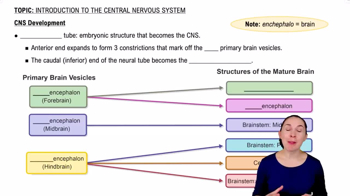
  • Three subdivisions of the brainstem

    1. Midbrain
    2. Pons
    3. Medulla oblongata