 뒤로
Lymphatic System - Anatomy & Physiology
 3:32

이 집합의 용어 (30)
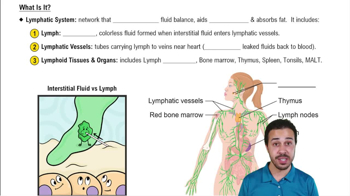
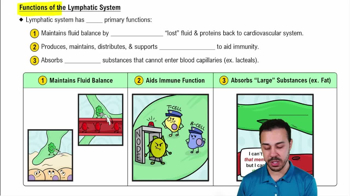
The lymphatic system maintains fluid balance, provides immune defense, and enables fat absorption.
It is the process where up to 3 L of fluid daily that leaks from blood capillaries into interstitial spaces is collected and returned to the blood.
They collect excess protein-rich interstitial fluid, return it to the blood, and transport pathogens to lymph nodes.
Lymphatic capillaries in the small intestine that absorb and transport digested fats as chyle.
Lymphoid organs and tissues provide sites for immune cell activation and proliferation.
They are blind-ended, more permeable than blood capillaries, and absent from bones and teeth.
They have thinner walls, more valves, and more anastomoses than veins.
The right lymphatic duct drains the right upper limb and right side of head/thorax; the thoracic duct drains the rest of the body.
An enlarged sac at the start of the thoracic duct present in about half of individuals.
Skeletal muscle contractions, thoracic pressure changes, arterial pulse waves, and smooth muscle contractions in vessel walls.
Insufficient lymph return causing localized edema, often due to tumors or surgical removal of lymph nodes.
T and B lymphocytes, macrophages, dendritic cells, and reticular cells.
Manage immune response and directly attack infected cells.
Produce plasma cells that secrete antibodies.
Phagocytize foreign substances and activate T cells.
Capture antigens and deliver them to lymph nodes for immune activation.
Produce reticular fibers that form the structural framework of lymphoid organs.
Diffuse tissue is loosely arranged in most organs; follicles are solid, spherical bodies with tightly packed cells.
Red bone marrow for B cell maturation; thymus for T cell maturation.
Lymph nodes, spleen, and MALT (tonsils, Peyer's patches, appendix) where immune responses occur.
Filter lymph, house lymphocytes, and provide sites for immune activation.
Abundant dendritic cells for antigen presentation.
B cells, T cells, and plasma cells.
Contain macrophages on reticular fibers that filter lymph.
Infected, swollen lymph nodes, such as those seen in bubonic plague.
White pulp handles immune functions; red pulp destroys old RBCs and pathogens.
The spleen can regenerate in children but not in adults.
Guards mucosal entryways against pathogens; includes tonsils, Peyer's patches, and appendix.
Trap debris and bacteria to build immune memory.
Clusters in the distal small intestine that generate memory lymphocytes.