What are the three main components of the lymphatic system?
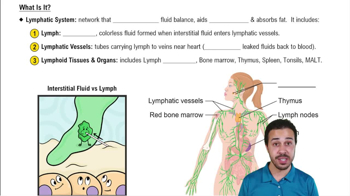
Network of lymphatic vessels, lymph fluid, and lymph nodes that cleanse lymph.
What is the primary function of lymphatic vessels?
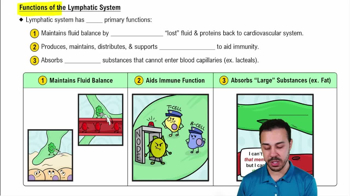
Return interstitial fluid and leaked plasma proteins back to the blood, about 3 liters per day.
What are lymphatic capillaries and how do they differ from blood capillaries?
Blind-ended tubes with overlapping endothelial cells forming one-way minivalves; very permeable and anchored by collagen filaments.
Where are lymphatic capillaries absent?
Absent from bones, teeth, bone marrow, and the central nervous system.
What are lacteals and their function?
Specialized lymphatic capillaries in the intestinal mucosa that absorb digested fats and deliver fatty lymph (chyle) to the blood.
Name the major lymphatic trunks.
Paired lumbar, bronchomediastinal, subclavian, jugular trunks, and a single intestinal trunk.
What are the two main lymphatic ducts and their drainage areas?
Right lymphatic duct drains right upper arm and right side of head and thorax; thoracic duct drains the rest of the body.
How is lymph propelled through lymphatic vessels?
By skeletal muscle contractions, thoracic pressure changes during breathing, valves preventing backflow, arterial pulsations, and smooth muscle contractions in vessel walls.
What are the two main types of lymphocytes and their roles?
T cells moderate immune responses and destroy infected cells; B cells produce plasma cells that secrete antibodies.
What is the role of macrophages in the lymphatic system?
Phagocytize foreign substances and help activate T cells.
What is the structure and function of lymph nodes?
Encapsulated organs with cortex and medulla; filter lymph by macrophages and activate lymphocytes to mount immune responses.
Describe the circulation of lymph through a lymph node.
Lymph enters via afferent vessels, flows through sinuses to medulla, and exits via fewer efferent vessels, allowing immune cells time to act.
What are the main functions of the spleen?
Lymphocyte proliferation, blood cleansing of aged cells, storage of iron and platelets, and possible fetal erythrocyte production.
How does the thymus differ from other lymphoid organs?
No B cells or follicles; functions strictly in T cell maturation and is most active during childhood.
What is MALT and where is it found?
Mucosa-associated lymphoid tissue; lymphoid tissues in mucous membranes like tonsils, Peyer's patches, and appendix.
What are the two lines of defense in the innate immune system?
First line: external body membranes (skin and mucosae); second line: antimicrobial proteins, phagocytes, natural killer cells, inflammation, and fever.
What are the cardinal signs of acute inflammation?
Redness, heat, swelling (edema), pain, and impairment of function.
What triggers the inflammatory response?
Chemicals like histamine released by mast cells and injured tissues that cause vasodilation and increased capillary permeability.
Describe the process of phagocytosis.
Phagocyte adheres to pathogen, engulfs it into a phagosome, fuses with lysosome to form phagolysosome, digests the pathogen, and expels residual material.
What are natural killer (NK) cells and their function?
Lymphocytes that attack cells lacking 'self' markers, inducing apoptosis in cancer and virus-infected cells, and enhance inflammation.
What are interferons and their role in innate immunity?
Proteins secreted by virus-infected cells that warn neighboring cells to produce antiviral proteins and activate NK cells.
What is the complement system and its functions?
A group of ~20 blood proteins that enhance inflammation, promote phagocytosis, and cause cell lysis of pathogens.
Name the three pathways of complement activation.
Classical (antibody-mediated), lectin (lectin binding to sugars), and alternative (spontaneous activation).
What is the membrane attack complex (MAC)?
A complex of complement proteins (C5b-C9) that forms pores in target cell membranes causing lysis.
What is opsonization in immune defense?
Coating of pathogens by complement proteins or antibodies to enhance phagocytosis.
What is leukocytosis and its role in inflammation?
An increase in white blood cells released from bone marrow to fight infection during inflammation.
Explain the steps of phagocyte mobilization during inflammation.
Leukocytosis, margination (adhesion to capillary walls), diapedesis (migration through capillaries), and chemotaxis (movement toward chemical signals).
 뒤로
 3:32