 뒤로
Male Reproductive Anatomy & Physiology
 2:08

이 집합의 용어 (29)
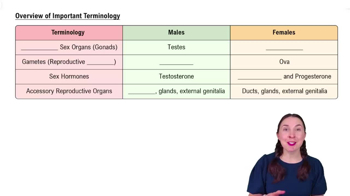
The male gonad where sperm production begins.
Skin-covered sac containing the testes; keeps them cooler than core body temperature for sperm viability.
Coiled tubes inside the testes where sperm are produced.
Support and nourish developing sperm; form the blood–testis barrier to protect sperm from immune attack.
Germline stem cells that give rise to sperm; also called primordial germ cells.
Network of veins around the testicular artery; helps cool incoming arterial blood to the testes.
Contains the ductus deferens, blood vessels, nerves, and lymphatics within connective tissue coverings.
Formed by tight junctions between Sertoli cells; protects developing sperm from immune system recognition.
Smooth muscle that wrinkles scrotal skin to reduce heat loss.
Primarily skeletal muscle that elevates the testes toward the body to conserve warmth.
Outer serous covering of the testis with parietal and visceral layers.
Tough inner fibrous capsule of the testis; extensions form septa dividing the testis into lobules.
Seminiferous tubules → straight tubules → rete testis → efferent ductules → epididymis → ductus deferens → ejaculatory duct → urethra → external urethral orifice.
Collecting network within the testis that channels sperm from seminiferous tubules.
Carry sperm from the rete testis to the epididymis.
Coiled structure along the posterior testis where sperm mature and are stored.
Thick-walled transport tube within the spermatic cord that carries sperm from the epididymis.
Expanded terminal portion of the ductus deferens behind the bladder; not a separate gland.
Formed where the ductus deferens joins the duct of a seminal gland; passes through the prostate.
Prostatic urethra, membranous (intermediate) urethra, and spongy urethra.
Accessory glands posterior to the bladder; add fluid containing fructose to fuel sperm.
Accessory gland inferior to the bladder; adds fluid with enzymes and other substances to semen.
Small paired glands inferior to the prostate; add lubricating mucus and help neutralize urethral acidity.
Two paired corpora cavernosa on dorsal side and one corpus spongiosum on ventral side surrounding the spongy urethra.
Contains the nucleus with haploid genetic material and the acrosome with enzymes to penetrate the egg.
Contains mitochondria that produce ATP for sperm motility.
Produces movement to propel the sperm.
Sperm are haploid cells containing 23 chromosomes, including either an X or Y sex chromosome.
Evaluated by morphology (shape), motility (movement), and number (count).