뒤로

Molecular Interactions in Anatomy & Physiology

컨트롤 버튼이 '내비게이션' 모드로 변경되었습니다.
1/28
  • What are the four major groups of biomolecules?

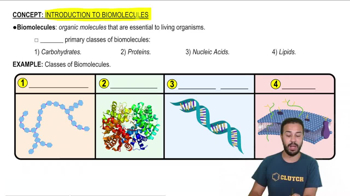
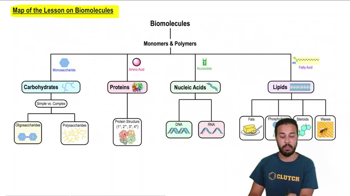
    Carbohydrates, lipids, proteins, and nucleotides are the four major groups of biomolecules.
  • What elements are most biomolecules primarily composed of?

    Most biomolecules contain carbon (C), hydrogen (H), and oxygen (O).
  • What is the backbone molecule of most lipids?

    The backbone of most lipids is glycerol, a 3-carbon molecule.
  • Describe the structure of a triglyceride.

    A triglyceride consists of glycerol combined with three fatty acids and is the most common lipid form in the body.
  • What are phospholipids and their role?

    Phospholipids have two fatty acids and a phosphate group; they are key components of cell membranes.
  • What are steroids and give an example?

    Steroids are four linked carbon rings; cholesterol is a common precursor steroid.
  • How are carbohydrates classified?

    Carbohydrates are classified by sugar units: monosaccharides, disaccharides, and polysaccharides.
  • Give examples of monosaccharides.

    Examples include glucose, fructose, galactose, ribose, and deoxyribose.
  • What is the function of polysaccharides like glycogen and cellulose?

    Glycogen stores energy in animals; cellulose provides structural support in plants.
  • What is the basic structure of an amino acid?

    An amino acid has a carboxyl group (–COOH), amino group (–NH2), hydrogen, and a variable R group.
  • What type of bond joins amino acids in proteins?

    A peptide bond joins amino acids via dehydration synthesis.
  • Name the four levels of protein structure.

    Primary (amino acid sequence), secondary (alpha helices and beta sheets), tertiary (3D folding), and quaternary (multiple subunits).
  • What are nucleotides composed of?

    Nucleotides consist of a phosphate group, 5-carbon sugar (ribose or deoxyribose), and a nitrogenous base.
  • List common functional groups in biological molecules.

    Common functional groups include amino (–NH2), carboxyl (–COOH), hydroxyl (–OH), and phosphate (–H2PO4).
  • What is the difference between cations and anions?

    Cations are positively charged ions (lost electrons); anions are negatively charged ions (gained electrons).
  • Name key physiological cations and anions.

    Cations: sodium (Na+), potassium (K+), calcium (Ca2+), magnesium (Mg2+). Anions: chloride (Cl–), bicarbonate (HCO3–), phosphate (HPO42–), sulfate (SO42–).
  • What are isotopes and ions?

    Isotopes are atoms with different numbers of neutrons; ions are atoms that have gained or lost electrons.
  • Compare covalent and ionic bonds.

    Covalent bonds share electrons and are strong; ionic bonds are electrostatic attractions between charged ions.
  • What are hydrogen bonds and van der Waals forces?

    Hydrogen bonds are weak attractions between H and O, N, or F; van der Waals forces are weak, nonspecific attractions.
  • Define hydrophilic and hydrophobic molecules.

    Hydrophilic molecules are polar or ionic and dissolve in water; hydrophobic molecules are nonpolar and do not dissolve in water.
  • How does pH relate to hydrogen ion concentration?

    pH measures H+ concentration: pH < 7 is acidic, pH > 7 is alkaline (basic).
  • What is the role of buffers in biological systems?

    Buffers, like bicarbonate, moderate changes in pH by absorbing or releasing H+ ions.
  • List major protein functions.

    Proteins function as enzymes, membrane transporters, signal molecules, receptors, binding proteins, immunoglobulins, and regulatory proteins.
  • What is the induced-fit model of protein binding?

    Proteins change shape to fit ligands specifically, enhancing binding and function.
  • Name factors that affect protein binding and activity.

    Factors include isoforms, activation (proteolytic, cofactors), chemical modulators (inhibitors, allosteric), and physical modulators (temperature, pH).
  • How do competitive and irreversible inhibitors differ?

    Competitive inhibitors compete with ligands at binding sites; irreversible inhibitors bind permanently and block activity.
  • What happens to proteins at extreme pH or temperature?

    Proteins can denature, losing their shape and function.
  • How does protein concentration affect reaction rate?

    Reaction rate increases with protein or ligand concentration until saturation is reached.