 뒤로
Muscle anatomy for quiz 8
 6:31

이 집합의 용어 (20)
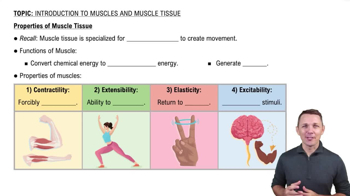
Movement, posture maintenance, joint stabilization, and heat generation are primary functions of the muscular system.
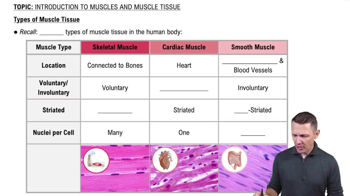
Voluntary control, striated appearance, multinucleated cells, and rapid contraction are key characteristics.
Epimysium surrounds the whole muscle, perimysium surrounds muscle fascicles, and endomycium surrounds individual muscle fibers.
The sarcomere is the basic contractile unit of skeletal muscle, extending from one Z disc to the next.
Includes Z discs, thin (actin) filaments, thick (myosin) filaments, A band, I band, and H zone.
Z discs anchor the thin filaments and define the boundaries of each sarcomere.
Actin proteins form thin filaments, along with regulatory proteins troponin and tropomyosin.
Myosin molecules make up thick filaments, which have heads that bind to actin during contraction.
The A band is the dark region containing the entire length of the thick filaments, including overlapping thin filaments.
The I band is the light region containing only thin filaments and spans two adjacent sarcomeres.
The H zone is the central part of the A band with only thick filaments and no overlapping thin filaments.
Epimysium protects the muscle from friction against other muscles and organs.
Perimysium groups muscle fibers into bundles called fascicles and carries blood vessels and nerves.
Endomysium surrounds individual muscle fibers and provides an extracellular environment for muscle cells.
Because skeletal muscle fibers form from fused myoblasts, they contain multiple nuclei to support high protein synthesis.
Striations result from the regular arrangement of thick and thin filaments in sarcomeres.
Muscle contractions produce heat as a byproduct, helping maintain body temperature.
Skeletal muscle contraction is controlled consciously via the somatic nervous system.
Optimal sarcomere length allows maximal overlap of thick and thin filaments for strongest contraction.
Myosin heads bind to actin, pivot, and pull thin filaments toward the sarcomere center during contraction.