 뒤로
Muscle Origins, Insertions, and Actions in Scapular and Shoulder Movement
 3:55

이 집합의 용어 (36)
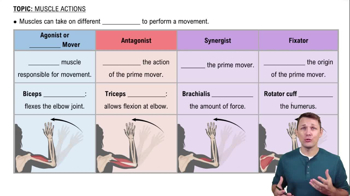
The fixed end of a muscle; usually the proximal attachment.
The movable end of a muscle; usually the distal attachment.
The motion a muscle creates when it contracts.
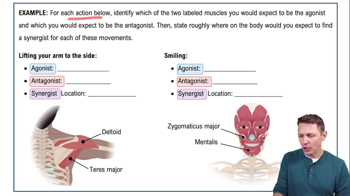
The prime mover primarily responsible for a specific movement.
The muscle that opposes the action of another muscle.
A muscle that helps an agonist work efficiently during movement.
Movement of the scapula relative to the thorax.
Movement of the humerus relative to the glenoid cavity of the scapula.
Transverse processes of C1-C4 vertebrae.
Vertebral border of scapula from superior angle to root of spine.
Scapular elevation and medial (downward) rotation.
Anterior surfaces of ribs 3, 4, and 5.
Coracoid process of scapula.
Scapular protraction, depression, medial rotation, anterior tilt; assists forced inhalation.
Spinous processes of T2-T5 vertebrae.
Vertebral border of scapula from root of spine to inferior angle.
Scapular adduction (retraction) and medial rotation.
Spinous processes of C7 and T1 vertebrae.
Root of spine of scapula.
Scapular adduction (retraction) and medial rotation.
Lateral surfaces of upper 8 ribs.
Anterior surface of vertebral border of scapula.
Scapular protraction and lateral rotation; stabilizes scapula.
Serratus anterior.
First rib.
Inferior border of clavicle.
Depresses clavicle and stabilizes sternoclavicular joint.
External occipital protuberance and ligamentum nuchae.
Lateral third of clavicle and acromion of scapula.
Scapular elevation and lateral (upward) rotation.
Spinous processes of C7-T3 vertebrae.
Spine of scapula.
Scapular adduction (retraction).
Spinous processes of T4-T12 vertebrae.
Root of spine of scapula.
Scapular depression and lateral (upward) rotation.