Skip to main content
Anatomy & Physiology
나의 코스
배우기
시험 준비
AI 튜터
학습 가이드
교과서적 해결책
플래시카드
탐험해 보세요
앱을 사용해 보세요
나의 코스
배우기
시험 준비
AI 튜터
학습 가이드
교과서적 해결책
플래시카드
탐험해 보세요
앱을 사용해 보세요
뒤로
Muscle Tissue and Skeletal Muscle Anatomy
카드를 뒤집기 위해 탭할 수 있습니다.
What are the three connective tissue sheaths in skeletal muscle?
카드를 뒤집기 위해 탭할 수 있습니다.
👆
What are the three connective tissue sheaths in skeletal muscle?
Epimysium
surrounds the entire muscle,
Perimysium
surrounds each fascicle, and
Endomysium
wraps each muscle fiber.
진행 상황 추적
컨트롤 버튼이 '내비게이션' 모드로 변경되었습니다.
1/29
추천 영상
VideoThumbView.guidedCourse
6:31
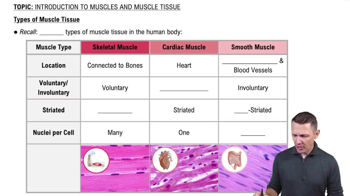
Types of Muscle Tissue
18723
views
494
rank
1
comments
VideoThumbView.guidedCourse
2:00
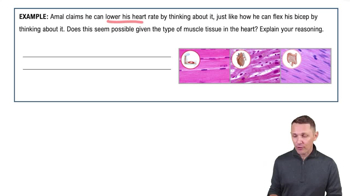
Introduction to Muscles and Muscle Tissue Example 1
16648
views
324
rank
VideoThumbView.guidedCourse
4:36
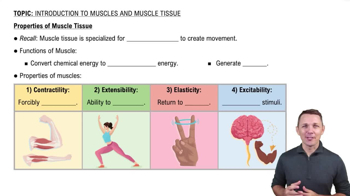
Properties of Muscle Tissue
25623
views
741
rank
2
comments
이 집합의 용어 (29)
하이드의 정의
What are the three connective tissue sheaths in skeletal muscle?
Epimysium
surrounds the entire muscle,
Perimysium
surrounds each fascicle, and
Endomysium
wraps each muscle fiber.
What is a fascicle in skeletal muscle?
A
fascicle
is a bundle of muscle fibers wrapped by the
perimysium
connective tissue sheath.
What is the role of tendons in muscle anatomy?
Tendons
connect muscle to bone and are continuous with the connective tissue sheaths of the muscle.
What is a motor unit?
A
motor unit
consists of a motor neuron and all the muscle fibers it innervates.
What is the neuromuscular junction?
The
neuromuscular junction
is the synapse where a motor neuron axon terminal meets a muscle fiber to signal contraction.
Define origin and insertion in muscle attachments.
Origin
is the less movable attachment, usually proximal;
insertion
is the more movable attachment, usually distal.
What is the sarcolemma?
The
sarcolemma
is the plasma membrane of a muscle fiber (cell).
What are myofibrils?
Myofibrils
are long rods within the muscle fiber cytoplasm that contain the contractile elements of muscle.
What is a sarcomere?
A
sarcomere
is the functional contractile unit of skeletal muscle, defined by the area between two Z discs.
What filaments compose a sarcomere?
Sarcomeres contain
thin (actin)
filaments and
thick (myosin)
filaments that slide to produce contraction.
What is the A band in a sarcomere?
The
A band
is the length of the thick filament and includes overlapping thin filaments.
What is the H zone?
The
H zone
is the central part of the A band where only thick filaments are present, no thin filaments.
What is the I band?
The
I band
contains only thin filaments and spans two adjacent sarcomeres.
What is the M line?
The
M line
is the center of the H zone, containing proteins that hold thick filaments together.
What is the sarcoplasmic reticulum and its function?
The
sarcoplasmic reticulum
is a specialized smooth ER that stores and releases calcium ions to trigger muscle contraction.
What are T tubules?
T tubules
are deep invaginations of the sarcolemma that conduct electrical impulses into the muscle fiber.
Explain the sliding filament theory.
Myosin heads attach to actin filaments and pull them inward, shortening the sarcomere and causing muscle contraction.
What is the role of calcium ions in muscle contraction?
Calcium ions released from the sarcoplasmic reticulum bind to regulatory proteins on actin, enabling myosin binding.
How does muscle fiber length affect contraction force?
Greatest force is produced when muscle fibers start slightly stretched, allowing optimal myosin-actin overlap.
What are the three types of skeletal muscle fibers?
1. Slow oxidative (Type I), 2. Fast glycolytic (Type IIx), 3. Fast oxidative (Type IIa), differing in contraction speed and energy use.
Characteristics of slow oxidative fibers (Type I)?
Red, rich in myoglobin and mitochondria, aerobic metabolism, slow contraction, fatigue-resistant, small diameter.
Characteristics of fast glycolytic fibers (Type IIx)?
White, low myoglobin, anaerobic metabolism, fast contraction, fatigue quickly, large diameter, powerful.
Characteristics of fast oxidative fibers (Type IIa)?
Intermediate diameter, aerobic metabolism, fast contraction, somewhat fatigue-resistant, high myoglobin.
What is muscular dystrophy?
A group of inherited diseases causing muscle degeneration and replacement by fat and connective tissue.
What is myofascial pain syndrome?
Pain caused by tightened bands of muscle fibers, often leading to chronic muscle discomfort.
What is fibromyalgia?
A chronic pain syndrome with fatigue, sleep issues, and widespread musculoskeletal pain, mostly affecting women.
When do skeletal muscles begin contracting during development?
Skeletal muscles contract by the seventh week of fetal development.
Where is cardiac muscle found and what are its features?
Found only in the heart walls; cells are striated and involuntary with branching fibers.
Where is smooth muscle found and what are its features?
Located in walls of hollow organs; cells are spindle-shaped, non-striated, and involuntary.
 뒤로뒤로
 6:31