Skip to main content
Anatomy & Physiology
나의 코스
배우기
시험 준비
AI 튜터
학습 가이드
교과서적 해결책
플래시카드
탐험해 보세요
앱을 사용해 보세요
나의 코스
배우기
시험 준비
AI 튜터
학습 가이드
교과서적 해결책
플래시카드
탐험해 보세요
앱을 사용해 보세요
뒤로
Muscular System - Anatomy & Physiology
카드를 뒤집기 위해 탭할 수 있습니다.
What are the three types of muscular tissue?
카드를 뒤집기 위해 탭할 수 있습니다.
👆
What are the three types of muscular tissue?
Skeletal muscle
,
cardiac muscle
, and
smooth muscle
.
진행 상황 추적
컨트롤 버튼이 '내비게이션' 모드로 변경되었습니다.
1/28
추천 영상
VideoThumbView.guidedCourse
6:31
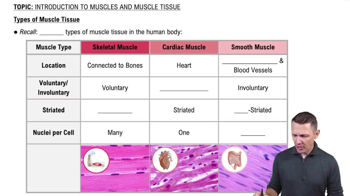
Types of Muscle Tissue
18703
views
494
rank
1
comments
VideoThumbView.guidedCourse
2:00
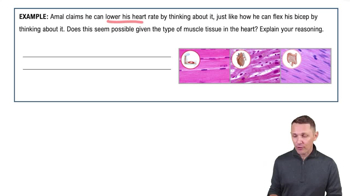
Introduction to Muscles and Muscle Tissue Example 1
16631
views
323
rank
VideoThumbView.guidedCourse
4:36
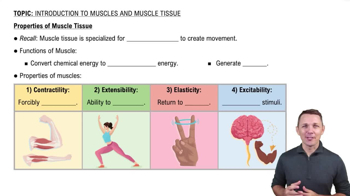
Properties of Muscle Tissue
25593
views
741
rank
2
comments
이 집합의 용어 (28)
하이드의 정의
What are the three types of muscular tissue?
Skeletal muscle
,
cardiac muscle
, and
smooth muscle
.
Where is skeletal muscle located and what is its cell shape?
Attached to bones or skin; cells are long, cylindrical, multinucleate, and striated.
What distinguishes cardiac muscle cells?
Branching chains of cells; uni- or binucleate; striated; found in heart walls.
Describe smooth muscle cells.
Single, spindle-shaped, uninucleate cells without striations; found in walls of hollow organs.
What are the four key characteristics of muscular tissue?
Excitability
,
contractility
,
extensibility
, and
elasticity
.
Define excitability in muscle tissue.
Ability to receive and respond to stimuli by producing a muscle action potential.
What is contractility in muscles?
The ability of muscles to shorten or lengthen while generating force.
What is the function of extensibility in muscle tissue?
Muscle tissue can be stretched or extended without damage.
Explain elasticity in muscles.
Muscles return to their original shape after being stretched.
List five functions of muscular tissue.
Produce body movements, stabilize body positions and joints, move substances within the body, generate heat, and regulate blood glucose concentration.
What are the connective tissue wrappings of skeletal muscle from outer to inner?
Epimysium
surrounds the whole muscle,
perimysium
surrounds fascicles, and
endomysium
surrounds individual muscle fibers.
What is a fascicle?
A discrete bundle of muscle cells surrounded by perimysium.
Describe a muscle fiber.
An elongated multinucleate muscle cell with a striated appearance, surrounded by endomysium.
What is fascia?
Collagen-rich fibrous connective tissue covering skeletal muscles, separating muscles or groups from each other.
What is a motor unit?
A motor neuron and all the muscle fibers it innervates.
Explain the all-or-none principle of muscle contraction.
When a motor unit is stimulated, all muscle fibers in that unit contract fully; no partial contractions occur.
What factors affect the maximum tension a muscle can generate?
Frequency of nerve impulses, size of motor units, amount of stretch before contraction, and nutrient/oxygen availability.
What is the length-tension relationship in muscle contraction?
The amount of stretch before contraction affects the force a muscle can generate.
What are the types of skeletal muscle fibers?
Type I
(slow oxidative),
Type IIa
(fast oxidative-glycolytic), and
Type IIb
(fast glycolytic).
What is muscular hypertrophy?
An increase in muscle fiber diameter caused by repeated mechanical overload and stimulated by hormones.
What causes muscular atrophy?
Disuse or denervation leading to a decrease in muscle fiber diameter and loss of myofibrils.
What is the sarcomere?
The basic functional unit of skeletal muscle fibers, composed of thick and thin filaments between two Z discs.
Name the contractile proteins in muscle fibers.
Actin
(thin filaments) and
myosin
(thick filaments).
What role do troponin and tropomyosin play in muscle contraction?
They are regulatory proteins that block or expose myosin binding sites on actin to control contraction.
Describe the four steps of cross-bridge cycling.
1. Cross bridge formation, 2. Power stroke, 3. Cross bridge detachment, 4. Cocking of myosin head.
What is muscle fatigue?
The inability of muscle to maintain force after prolonged activity due to factors like calcium depletion and lactic acid buildup.
What is muscle tone?
A small amount of continuous tension in muscles due to weak, alternating contractions of motor units.
Differentiate isotonic and isometric muscle contractions.
Isotonic: muscle length changes with constant tension; Isometric: muscle length stays the same with tension insufficient to move load.
 뒤로뒤로
 6:31