Skip to main content
Anatomy & Physiology
나의 코스
배우기
시험 준비
AI 튜터
학습 가이드
교과서적 해결책
플래시카드
탐험해 보세요
앱을 사용해 보세요
나의 코스
배우기
시험 준비
AI 튜터
학습 가이드
교과서적 해결책
플래시카드
탐험해 보세요
앱을 사용해 보세요
뒤로
Muscular System - Anatomy & Physiology
카드를 뒤집기 위해 탭할 수 있습니다.
What connective tissues surround skeletal muscle fibers, fascicles, and the entire muscle?
카드를 뒤집기 위해 탭할 수 있습니다.
👆
What connective tissues surround skeletal muscle fibers, fascicles, and the entire muscle?
Endomysium
surrounds individual muscle fibers,
perimysium
surrounds fascicles, and
epimysium
encloses the entire muscle.
진행 상황 추적
컨트롤 버튼이 '내비게이션' 모드로 변경되었습니다.
1/28
추천 영상
VideoThumbView.guidedCourse
8:11
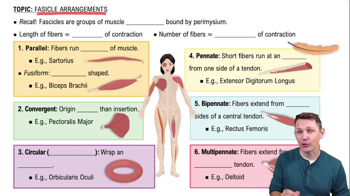
Fascicle Arrangements
8860
views
177
rank
VideoThumbView.guidedCourse
2:29
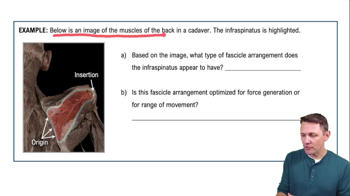
Fascicle Arrangements Example 1
6210
views
98
rank
이 집합의 용어 (28)
하이드의 정의
What connective tissues surround skeletal muscle fibers, fascicles, and the entire muscle?
Endomysium
surrounds individual muscle fibers,
perimysium
surrounds fascicles, and
epimysium
encloses the entire muscle.
Define a motor unit in skeletal muscle.
A
motor unit
consists of a single motor neuron and all the muscle cells it innervates, controlling muscle contraction.
How does the number of muscle cells in a motor unit affect movement precision?
Fewer muscle cells in a motor unit allow for
more precise movements
.
Describe the parallel fascicle arrangement in skeletal muscles.
Fascicles run
parallel
to the long axis of the muscle; muscle and tendon have the same width.
What characterizes a convergent muscle fascicle arrangement?
Fascicles are broad and triangular, tapering to a single tendon.
Explain the pennate fascicle arrangement and its variations.
Fascicles attach to tendon at an
angle
, resembling a feather; variations include unipennate, bipennate, and multipennate.
What is the function of sphincter muscles?
Sphincters have circular fascicles that
surround body openings
and provide voluntary control over opening and closing.
How are muscles commonly named in anatomy?
Muscles are named based on
location
,
anatomical structures
they attach to,
actions
performed, or
appearance
.
List the four functional groups of muscles involved in movement.
Agonists
(prime movers),
antagonists
,
synergists
, and
fixators
.
What is the difference between muscle origin and insertion?
The
origin
is the fixed anchoring point, usually not moving; the
insertion
is the moving end attached to the bone or structure.
Name the primary muscles involved in mastication (chewing).
The
masseter
and
temporalis
muscles elevate the mandible for biting and chewing.
Which muscles move the head and neck?
Key muscles include
sternocleidomastoid
,
scalenes
, and
trapezius
.
What is the role of the erector spinae muscles?
They are powerful
extensors
of the spine and assist in lateral bending and rotation.
Which muscles are involved in respiration?
The
diaphragm
,
internal intercostals
, and
external intercostals
.
Name the four abdominal muscles.
Rectus abdominis
,
external obliques
,
internal obliques
, and
transversus abdominis
.
Which muscles move the scapula?
Muscles include
serratus anterior
,
pectoralis minor
,
trapezius
,
levator scapulae
, and
rhomboids
.
What muscles form the rotator cuff group?
Teres minor
,
supraspinatus
,
infraspinatus
, and
subscapularis
.
Which muscles flex the elbow joint?
Biceps brachii
,
brachialis
, and
brachioradialis
.
Name the muscles that extend the elbow joint.
The
triceps brachii
muscle extends the elbow.
Which muscles flex the thigh at the hip?
Iliopsoas
and
sartorius
muscles flex the thigh.
What muscle group extends the leg at the knee?
The
quadriceps femoris
group: rectus femoris, vastus lateralis, vastus medialis, and vastus intermedius.
Which muscles adduct the thigh?
Adductor magnus
,
adductor longus
, and
adductor brevis
.
Name the gluteal muscles and their general functions.
Gluteus maximus
,
medius
, and
minimus
extend, abduct, and rotate the thigh.
Which muscles flex the leg at the knee (hamstrings)?
Biceps femoris
,
semitendinosus
, and
semimembranosus
.
What muscles dorsiflex the foot at the ankle?
Tibialis anterior
and
extensor digitorum longus
.
Which muscles plantar flex the foot at the ankle?
The
triceps surae
group:
soleus
and
gastrocnemius
.
Name muscles that evert the foot.
Fibularis longus
and
fibularis brevis
.
Which muscles invert the foot?
Tibialis posterior
and
tibialis anterior
.
 뒤로
 8:11