 뒤로
Muscular System - Anatomy & Physiology
 6:31

이 집합의 용어 (20)
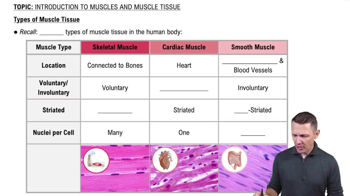
Skeletal, cardiac, and smooth muscle tissues.
To produce voluntary movement by contracting and pulling on bones.
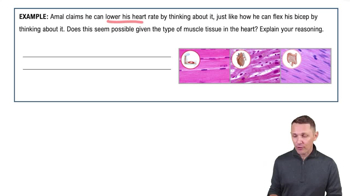
Found only in the heart; it contracts to pump blood throughout the body.
Involuntary, non-striated muscle found in walls of hollow organs like intestines and blood vessels.
A single muscle cell, long and cylindrical, containing multiple nuclei.
Myofibrils are contractile elements composed of sarcomeres that enable muscle contraction.
The basic contractile unit of muscle fiber, made of actin and myosin filaments.
Thin filaments are primarily actin; thick filaments are primarily myosin.
Myosin heads bind to actin and pull filaments past each other using ATP, shortening the sarcomere.
Calcium binds to troponin, causing tropomyosin to move and expose binding sites on actin for myosin.
The synapse where a motor neuron communicates with a muscle fiber to trigger contraction.
Acetylcholine (ACh) is released to stimulate muscle contraction.
Origin is the fixed attachment point; insertion is the movable attachment point of a muscle.
Isotonic changes muscle length to move a load; isometric generates force without changing length.
An increase in muscle size due to growth of individual muscle fibers.
Endomysium surrounds fibers, perimysium surrounds fascicles, epimysium surrounds the entire muscle.
ATP provides energy for myosin head movement and detachment from actin during contraction cycles.
Depletion of ATP, accumulation of lactic acid, and ionic imbalances impair contraction.
Muscle contraction occurs as actin filaments slide over myosin filaments, shortening sarcomeres.
A motor unit is one motor neuron and all the muscle fibers it innervates; smaller units allow finer control.