 뒤로
Muscular System Anatomy & Physiology
 5:39

이 집합의 용어 (21)
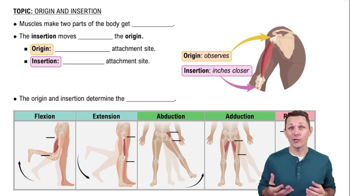
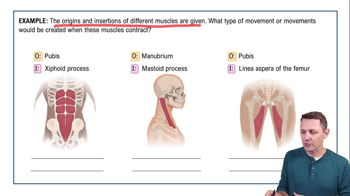
Origin is the attachment to an immovable or less movable bone. Insertion is the attachment to a movable bone. During contraction, the insertion moves toward the origin.
Prime mover causes the main movement. Antagonist opposes the prime mover. Synergist aids the prime mover or reduces unwanted movement. Fixator stabilizes the origin of the prime mover.
1. All skeletal muscles cross at least one joint.
2. Bulk lies proximal to joint.
3. Have origin and insertion.
4. Muscles only pull, never push.
5. Insertion moves toward origin during contraction.
Movement that decreases the angle of a joint, bringing two bones closer together. Typical in bending hinge or ball-and-socket joints.
Extension increases the angle between bones, straightening a joint. Hyperextension is extension beyond the normal anatomical position.
Movement of a bone around its longitudinal axis, common in ball-and-socket joints. Example: shaking the head "no" by rotating the atlas around the axis.
Abduction moves a limb away from the midline. Adduction moves a limb toward the midline.
Combination of flexion, extension, abduction, and adduction where the distal end of a limb moves in a circle while the proximal end remains stationary.
Dorsiflexion lifts the foot so the superior surface approaches the shin. Plantar flexion points the toes away from the head.
Inversion turns the sole of the foot medially. Eversion turns the sole laterally.
Supination rotates the forearm laterally so the palm faces anteriorly; radius and ulna are parallel.
Pronation rotates the forearm medially so the palm faces posteriorly; radius and ulna cross.
Movement of the thumb to touch the tips of other fingers on the same hand, enabling grasping.
Muscles are named by fiber direction, size, location, number of origins, origin/insertion location, shape, and action.
Direction: rectus (straight)
Size: maximus (largest)
Location: temporalis (temporal bone)
Number of origins: triceps (three heads)
Shape: deltoid (triangular)
Action: flexor, extensor
Circular, convergent, parallel, fusiform, and pennate fascicle arrangements describe how muscle fibers are organized relative to tendons.
Fascicles arranged in concentric rings, often surrounding external body openings.
Fascicles converge toward a single insertion tendon, allowing versatile movement directions.
Parallel fascicles run along the muscle's long axis. Fusiform is a spindle-shaped variant of parallel arrangement.
Short fascicles attach obliquely to a central tendon, increasing muscle power.
Nerve supply is essential for muscle contraction. Regular exercise maintains muscle health, preventing atrophy and promoting hypertrophy.
Muscle control matures from superior to inferior and proximal to distal. Aging decreases muscle mass and strength, but exercise helps retain them.