 뒤로
Muscular System - Anatomy & Physiology
 6:31

이 집합의 용어 (20)
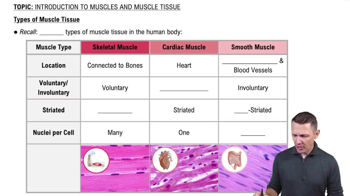
Skeletal, smooth, and cardiac muscle tissues.
Skeletal muscle is under voluntary (conscious) control.
To produce movement of the skeleton and maintain posture.
Found in walls of hollow organs; it is involuntary muscle.
It is involuntary, striated muscle found only in the heart.
Myosin heads pull actin filaments inward, causing muscle shortening and contraction.
Actin filaments slide inward while myosin remains stationary.
Interaction between actin and myosin filaments powered by ATP.
Direct phosphorylation, anaerobic glycolysis, and aerobic respiration.
Depletion of energy sources and accumulation of metabolic wastes during prolonged activity.
Isotonic (muscle changes length) and isometric (muscle length stays the same).
Muscle changes length to produce movement, either concentric or eccentric.
Muscle generates force without changing length, stabilizing joints.
Rules that describe how muscles produce movement and interact during contraction.
Flexion, extension, abduction, adduction, rotation, and circumduction.
Location, shape, size, direction of fibers, number of origins, and action.
The fixed attachment point of a muscle, usually proximal or less movable.
The movable attachment point of a muscle, usually distal.
It helps explain the direction and effect of muscle contraction on body movement.
More than 600 muscles.