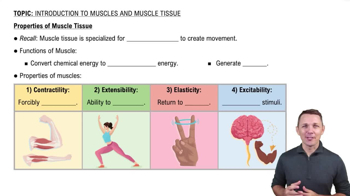
Muscle tissue is specialized to contract to create movement by converting chemical energy to mechanical energy.
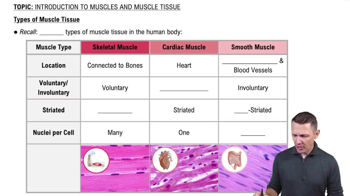
Name the 3 types of muscle tissue in the human body.
Skeletal muscle, cardiac muscle, and smooth muscle.
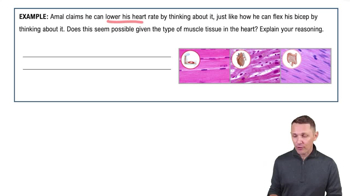
How do skeletal, cardiac, and smooth muscles differ in striation and control?
Skeletal muscle is striated and voluntary, cardiac muscle is striated and involuntary, smooth muscle is non-striated and involuntary.
What are the four key properties of muscle tissue?
Contractility (forceful shortening), extensibility (ability to stretch), elasticity (return to original length), and excitability (respond to stimuli).
What is a muscle fiber?
A muscle fiber is a long, multinucleated muscle cell surrounded by endomysium.
What is a fascicle in muscle tissue?
A fascicle is a bundle of muscle fibers surrounded by perimysium.
What connective tissue surrounds an entire muscle?
The entire muscle is surrounded by epimysium.
What are myofilaments and what are the two main types?
Myofilaments are protein filaments within myofibrils; the two main types are actin (thin) and myosin (thick) filaments.
What is the sarcomere?
The sarcomere is the smallest contractile unit of a muscle fiber, composed of overlapping actin and myosin filaments.
Describe the sliding filament theory of muscle contraction.
During contraction, myosin heads pull actin filaments toward the center of the sarcomere, shortening the muscle without changing filament length.
What role does calcium play in muscle contraction?
Calcium binds to troponin, causing tropomyosin to move and expose myosin binding sites on actin, enabling contraction.
What is the function of tropomyosin in muscle fibers?
Tropomyosin blocks myosin binding sites on actin when the muscle is relaxed, preventing contraction.
What is the role of ATP in the cross-bridge cycle?
ATP binds to myosin, causing it to release actin, then is hydrolyzed to cock the myosin head for the next power stroke.
What happens during the power stroke in muscle contraction?
The myosin head pivots, pulling the actin filament toward the sarcomere center, shortening the muscle.
What is the neuromuscular junction?
The neuromuscular junction is the synapse where a motor neuron communicates with a muscle fiber using acetylcholine.
What initiates an action potential in a muscle fiber?
Acetylcholine released from the motor neuron binds to receptors on the sarcolemma, triggering an action potential.
What is excitation-contraction coupling?
The process where an action potential travels along the sarcolemma and T-tubules, causing calcium release and muscle contraction.
What are the main bands and lines in a sarcomere?
A band contains thick and thin filaments, I band contains thin filaments only, H zone contains thick filaments only, Z disc marks sarcomere boundaries, and M line is the center of thick filaments.
How do the A band, I band, and H zone change during muscle contraction?
The A band stays the same length, the I band and H zone shorten as filaments slide past each other.
What is the function of the sarcoplasmic reticulum in muscle fibers?
The sarcoplasmic reticulum stores and releases calcium ions to trigger muscle contraction.
 뒤로
 6:31