 뒤로
Muscular System Basics - Anatomy & Physiology
 6:31

이 집합의 용어 (20)
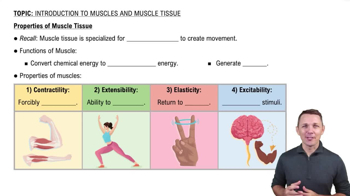
The muscular system enables movement of the body, maintains posture, and produces heat through muscle contractions.
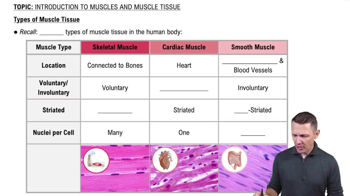
Skeletal, cardiac, and smooth muscle tissues.
Attached to bones; it is under voluntary control.
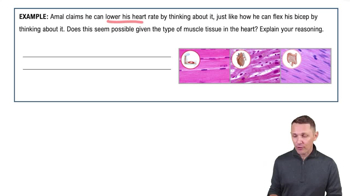
Found only in the heart; it is involuntary and has intercalated discs for synchronized contractions.
Located in walls of hollow organs; it is involuntary and non-striated.
A single muscle cell, typically long and multinucleated, that contracts in response to stimulation.
Threadlike structures within muscle fibers composed of repeating units called sarcomeres, responsible for contraction.
The basic functional unit of a muscle fiber, made of actin and myosin filaments.
Myosin forms thick filaments; actin forms thin filaments.
Calcium binds to troponin, causing a shift that allows myosin to bind actin and initiate contraction.
During contraction, actin filaments slide past myosin filaments, shortening the sarcomere and muscle fiber.
The synapse where a motor neuron communicates with a muscle fiber to trigger contraction.
Acetylcholine (ACh) is released at the neuromuscular junction to stimulate muscle fibers.
Continuous, partial contraction of muscles that maintains posture and readiness for action.
Muscle changes length while tension remains constant, producing movement.
Muscle length remains the same while tension increases, no movement occurs.
ATP provides energy for myosin head movement and detachment from actin during contraction cycles.
Oxygen is required for aerobic respiration to produce ATP efficiently during sustained muscle activity.
Accumulation of lactic acid and depletion of ATP reduce muscle's ability to contract effectively.
Tendons connect muscles to bones, transmitting force to produce movement.