Skip to main content
Anatomy & Physiology
나의 코스
배우기
시험 준비
AI 튜터
학습 가이드
교과서적 해결책
플래시카드
탐험해 보세요
앱을 사용해 보세요
나의 코스
배우기
시험 준비
AI 튜터
학습 가이드
교과서적 해결책
플래시카드
탐험해 보세요
앱을 사용해 보세요
뒤로
Muscular System Fundamentals - Anatomy & Physiology
카드를 뒤집기 위해 탭할 수 있습니다.
What are the four main types of fascicle arrangements in skeletal muscles?
카드를 뒤집기 위해 탭할 수 있습니다.
👆
What are the four main types of fascicle arrangements in skeletal muscles?
Parallel, convergent, pennate, and circular
fascicle arrangements determine muscle function and force.
진행 상황 추적
컨트롤 버튼이 '내비게이션' 모드로 변경되었습니다.
1/31
추천 영상
VideoThumbView.guidedCourse
6:31
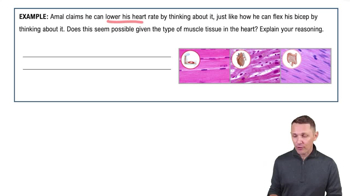
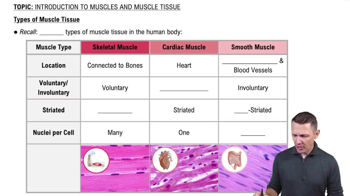
Types of Muscle Tissue
18705
views
494
rank
1
comments
VideoThumbView.guidedCourse
2:00
Introduction to Muscles and Muscle Tissue Example 1
16633
views
323
rank
VideoThumbView.guidedCourse
4:36
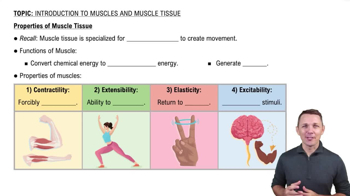
Properties of Muscle Tissue
25598
views
741
rank
2
comments
이 집합의 용어 (31)
하이드의 정의
What are the four main types of fascicle arrangements in skeletal muscles?
Parallel, convergent, pennate, and circular
fascicle arrangements determine muscle function and force.
Describe the characteristics of parallel muscles.
Fascicles run
parallel to the long axis
of the muscle, often cylindrical with a central belly, e.g., biceps brachii.
What defines convergent muscles?
Muscle fibers
spread out like a fan and converge
on a single attachment site, allowing fibers to pull in different directions, e.g., pectoralis.
How do pennate muscles differ from parallel muscles?
Pennate muscles have fibers that
pull at an angle
to the tendon, contain more myofibrils, and develop more tension but move tendons less.
Name the three types of pennate muscles with examples.
Unipennate
(extensor digitorum),
bipennate
(rectus femoris), and
multipennate
(deltoid).
What is the function of circular muscles?
Circular muscles act as
valves or sphincters
around body openings, contracting to decrease the diameter, e.g., orbicularis oris.
What is a lever in the context of the muscular system?
A bone acts as a
rigid lever
that moves on a fixed point (fulcrum) when muscles apply force to overcome a load.
Describe the three classes of levers in the body.
First-class:
fulcrum between force and load;
Second-class:
load between force and fulcrum;
Third-class:
force between load and fulcrum.
Give an example of a first-class lever in the body.
Extension of the neck and lifting the head, where the fulcrum is between applied force and load.
What is the mechanical advantage of a second-class lever?
Small force moves a large load, maximizing force but reducing speed and distance, e.g., ankle plantar flexion by calf muscles.
Why are third-class levers most common in the body?
They maximize
speed and range of motion
at the expense of force, e.g., biceps brachii acting on the forearm.
Define origin and insertion of a muscle.
The
origin
is the fixed, usually proximal attachment; the
insertion
is the movable attachment point.
What are agonist and antagonist muscles?
The
agonist
is the prime mover producing a movement; the
antagonist
opposes that movement.
What roles do synergist and fixator muscles play?
A
synergist
assists the agonist; a
fixator
stabilizes a joint to allow the agonist to act efficiently.
How do agonist and antagonist muscles interact during movement?
They work in pairs; when the agonist contracts, the antagonist stretches to allow smooth motion.
What information can muscle names provide?
Muscle names indicate
location, shape, size, origin/insertion, fascicle arrangement, and action
.
Give examples of terms indicating muscle location.
Examples include
brachial
(arm),
carpi
(wrist),
cervicis
(neck), and
femoris
(thigh).
What do terms like externus and internus indicate about muscles?
Externus (superficialis)
muscles are near the surface;
internus (profundus)
muscles are deeper.
Explain the significance of terms like biceps, triceps, and quadriceps.
They indicate the
number of muscle heads or tendons
: two, three, and four respectively.
List common terms indicating muscle actions.
Examples:
flexor
(bends),
extensor
(straightens),
abductor
(moves away),
adductor
(moves toward).
What are the two main divisions of the muscular system?
Axial muscles
(60% of skeletal muscles) position head, vertebral column, and rib cage;
appendicular muscles
move and support limbs and girdles.
Name the groups of axial muscles based on location and function.
Muscles of the head and neck, vertebral column, oblique and rectus muscles, and pelvic floor muscles.
What are the muscles of facial expression and their general origin?
They originate on the skull and control facial movements, e.g., orbicularis oris and buccinator.
Which muscles control eye movement and where do they originate?
Extrinsic eye muscles originate on the orbit surface and include superior, inferior, medial, and lateral rectus and oblique muscles.
What are the primary muscles of mastication?
Masseter (strongest jaw muscle), temporalis (elevates mandible), and pterygoid muscles (move mandible side to side).
Name the muscles of the tongue mentioned.
Palatoglossus, styloglossus, genioglossus, and hyoglossus, all named for origin and insertion.
What is the role of pharyngeal constrictor muscles?
They move food into the esophagus during swallowing.
Identify key muscles of the anterior neck and their functions.
Digastric controls larynx position; mylohyoid elevates mouth floor; sternocleidomastoid turns the head.
What are the major groups of erector spinae muscles?
Superficial layer: spinalis, longissimus, iliocostalis groups; deep layer: semispinalis, multifidus, rotatores.
What is the function of oblique and rectus muscles in the body wall?
Obliques compress and rotate the vertebral column; rectus muscles flex the vertebral column.
What is the diaphragm's role in the muscular system?
It divides thoracic and abdominopelvic cavities and is the major muscle used in breathing.
 뒤로뒤로
 6:31