 뒤로
Muscular System: Muscle Types, Levers, and Movements
 8:11

이 집합의 용어 (20)
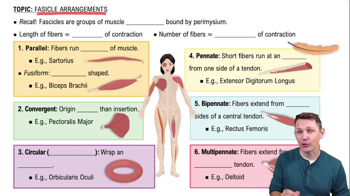
Parallel muscles have fascicles running parallel to the muscle's long axis, allowing significant shortening during contraction. Examples include the biceps brachii and rectus abdominis.
Convergent muscles have fascicles spreading over a broad area and converging on a single attachment point, allowing pulling in different directions. Example: pectoralis major.
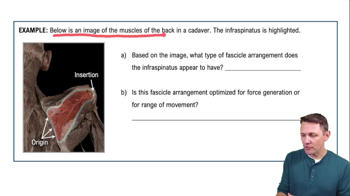
Pennate muscles have fascicles at an angle to the tendon, producing more tension. Types: unipennate (one side, e.g., extensor digitorum), bipennate (both sides, e.g., rectus femoris), and multipennate (tendon branches, e.g., deltoid).
Circular muscles have fascicles arranged concentrically around an opening, acting as valves. Example: orbicularis oris, which controls lip movement.
In a first-class lever, the fulcrum is between the applied force and the load. Example: extension of the neck lifting the head.
A second-class lever has the load between the applied force and the fulcrum. Example: ankle extension (plantar flexion) by calf muscles.
A third-class lever has the applied force between the load and fulcrum. It is most common in the body. Example: elbow flexion by the biceps brachii.
Flexors decrease the angle at a joint by contracting. Example: the biceps brachii flexes the elbow.
Extensors increase the angle at a joint by contracting. Example: the triceps brachii extends the elbow.
Abduction moves a limb away from the midline. The gluteus medius and minimus abduct the hip.
Adduction moves a limb toward the midline. The adductor magnus is a major hip adductor.
Medial rotators include the subscapularis, rotating the shoulder medially. Lateral rotators include the teres minor, rotating the shoulder laterally.
Axial muscles position the head, neck, and trunk (e.g., sternocleidomastoid). Appendicular muscles move the limbs and girdles (e.g., deltoid, biceps brachii).
Key facial muscles include orbicularis oris (lips), buccinator (cheeks), zygomaticus major (smiling), and platysma (neck skin tension).
Extrinsic eye muscles control eye movement: superior, inferior, medial, lateral rectus, and superior and inferior oblique muscles.
Mastication muscles include the masseter and temporalis (elevate mandible) and pterygoid muscles (move mandible side to side).
Forearm flexors: biceps brachii, brachialis. Extensors: triceps brachii. Wrist and finger movers include flexor carpi radialis, extensor digitorum.
Gluteal muscles: gluteus maximus, medius, minimus. Thigh muscles: quadriceps femoris, hamstrings. Calf muscles: gastrocnemius, soleus.
The mechanical advantage of a lever is \(\frac{\text{effort arm}}{\text{load arm}}\).
Muscles increase oxygen demand, stimulating the cardiovascular and respiratory systems. Heat from muscle activity is dispersed by the integumentary system, coordinated by nervous and endocrine systems.