 뒤로
뒤로Nervous System Anatomy & Physiology
 04:36
04:36
이 집합의 용어 (27)
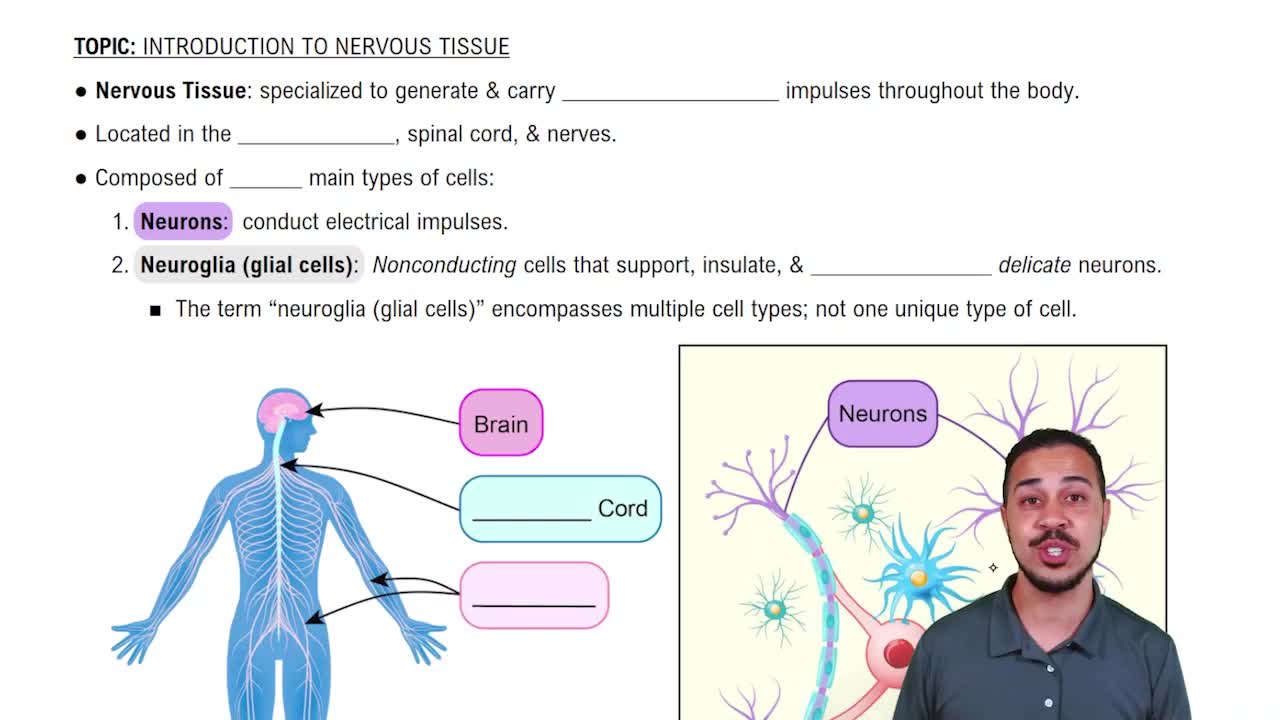
The nervous system is divided into the central nervous system (CNS) and the peripheral nervous system (PNS). The CNS includes the brain and spinal cord, while the PNS includes all neural tissue outside the CNS.
A neuron consists of the cell body (soma), dendrites (receive signals), and an axon (transmits signals away from the cell body).
Dendrites receive incoming signals from other neurons and transmit them toward the cell body.
The axon conducts electrical impulses away from the cell body to other neurons or effector cells.
A synapse includes the presynaptic terminal (axon terminal), synaptic cleft (gap), and postsynaptic membrane (on dendrite or cell body).
The presynaptic terminal releases neurotransmitters into the synaptic cleft to transmit signals.
The synaptic cleft is the space where neurotransmitters diffuse to reach the postsynaptic membrane.
The postsynaptic membrane contains receptors that bind neurotransmitters to propagate the signal.
Major CNS glial cells include astrocytes, oligodendrocytes, microglia, and ependymal cells.
Astrocytes support neurons, maintain the blood-brain barrier, regulate ion balance, and repair tissue.
Oligodendrocytes produce myelin sheaths that insulate CNS axons to speed conduction.
Microglia act as immune cells in the CNS, removing debris and pathogens.
Ependymal cells line ventricles and produce cerebrospinal fluid (CSF).
Gray matter consists mainly of neuronal cell bodies, dendrites, and unmyelinated axons.
White matter is composed primarily of myelinated axons forming tracts for communication.
Tracts are bundles of myelinated axons in the CNS that connect different regions.
Nuclei are clusters of neuron cell bodies within the CNS with specific functions.
CSF is produced by the choroid plexus in the brain ventricles through filtration and secretion.
CSF circulates through the ventricles, central canal of the spinal cord, and subarachnoid space around the brain and spinal cord.
CSF cushions the brain, removes waste, and provides a stable chemical environment.
The blood-brain barrier consists of endothelial cells with tight junctions, supported by astrocyte end-feet.
It protects the brain by regulating substance passage from blood to neural tissue, maintaining homeostasis.
The cerebrum includes the frontal, parietal, temporal, and occipital lobes, each with distinct functions.
The cerebellum has two hemispheres and a central vermis, coordinating movement and balance.
The diencephalon includes the thalamus, hypothalamus, and epithalamus, involved in sensory relay and autonomic control.
The brain stem consists of the midbrain, pons, and medulla oblongata, controlling vital functions.
The brain stem connects the spinal cord to the cerebrum and cerebellum; the diencephalon lies above the brain stem; the cerebrum is the largest, most superior part.