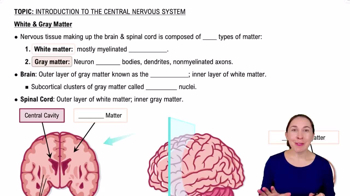
What are the main components of the Central Nervous System (CNS)?
The brain and spinal cord form the CNS.
Define cephalization in nervous system development.
Cephalization is the evolutionary development of the anterior CNS with an increased number of neurons in the head, highest in humans.
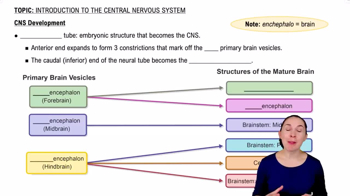
What are the three primary brain vesicles formed during embryonic development?
The prosencephalon (forebrain), mesencephalon (midbrain), and rhombencephalon (hindbrain).
Name the four adult brain regions.
Cerebral hemispheres, diencephalon, brain stem (midbrain, pons, medulla), and cerebellum.
What is the function of the cerebral cortex?
The cerebral cortex is the thin outer gray matter layer responsible for conscious mind functions like awareness, sensory perception, voluntary movement, communication, memory, and understanding.
List the five lobes of the cerebral hemispheres.
Frontal, parietal, temporal, occipital, and insula lobes.
What are the three basic regions of the cerebral hemispheres?
Cerebral cortex (gray matter), white matter internally, and basal nuclei deep within white matter.
What is the role of the primary motor cortex?
It allows conscious control of precise, skilled skeletal muscle movements and contains motor homunculi representing contralateral body regions.
What functions does the premotor cortex serve?
It helps plan movements, controls learned motor skills, and voluntary actions dependent on sensory feedback.
Describe Broca's area and its function.
Broca's area, usually in the left hemisphere, is the motor speech area directing muscles for speech production and planning voluntary motor activities.
What are the three types of functional areas in the cerebral cortex?
Motor areas (voluntary movement), sensory areas (conscious sensation), and association areas (integrate information).
What is lateralization of cortical function?
Each hemisphere specializes in certain functions and controls the contralateral side of the body.
Name the three parts of the multimodal association areas.
Anterior association area (prefrontal cortex), posterior association area, and limbic association area.
What functions are associated with the anterior association area (prefrontal cortex)?
Involved in intellect, cognition, recall, personality, and contains working memory for abstract ideas, judgment, reasoning, and planning.
What is the role of the posterior association area?
It helps recognize patterns and faces, localizes us in space, and is involved in understanding written and spoken language.
What is the function of the limbic association area?
It provides the emotional impact that makes experiences important and helps establish memories.
What are the three paired structures of the diencephalon?
Thalamus, hypothalamus, and epithalamus.
What is the main function of the thalamus?
The thalamus acts as the gateway to the cerebral cortex, relaying sensory information.
List key functions of the hypothalamus.
Controls autonomic nervous system, physical responses to emotions, biological rhythms, drives, and helps regulate the sleep-wake cycle.
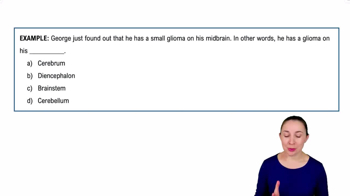
What are the three regions of the brain stem?
Midbrain, pons, and medulla oblongata.
What are the main functions of the cerebellum?
Coordinates smooth movements, plays a role in thinking, language, and emotion, and adjusts motor output by comparing actual with expected results.
What does an EEG measure?
An EEG records electrical activity of the brain by measuring potential differences between cortical areas.
Name the four general classes of brain waves.
Alpha (awake, relaxed), beta (awake, alert), theta (common in children), and delta (deep sleep).
What is consciousness in terms of brain function?
Consciousness is the perception of sensation, voluntary movement control, and higher mental processing like memory and judgment.
Describe the importance of sleep.
Sleep cycles reflect circadian rhythms; slow-wave sleep is restorative, REM sleep may purge useless information, and sleep needs decline with age.
What are the protective structures of the brain?
Protection is provided by bone (skull), meninges, cerebrospinal fluid, and the blood-brain barrier.
Name the three layers of meninges.
Dura mater, arachnoid mater, and pia mater.
What is cerebrospinal fluid (CSF) and its functions?
CSF is a watery solution that buoys the CNS, protects from trauma, nourishes the brain, and carries chemical signals.
List common traumatic brain injuries.
Concussion (temporary function alteration), contusion (permanent damage), hemorrhages, and cerebral edema (brain swelling).
 뒤로
 0:50