 뒤로
Nervous Tissue in Anatomy & Physiology
 04:36

이 집합의 용어 (20)
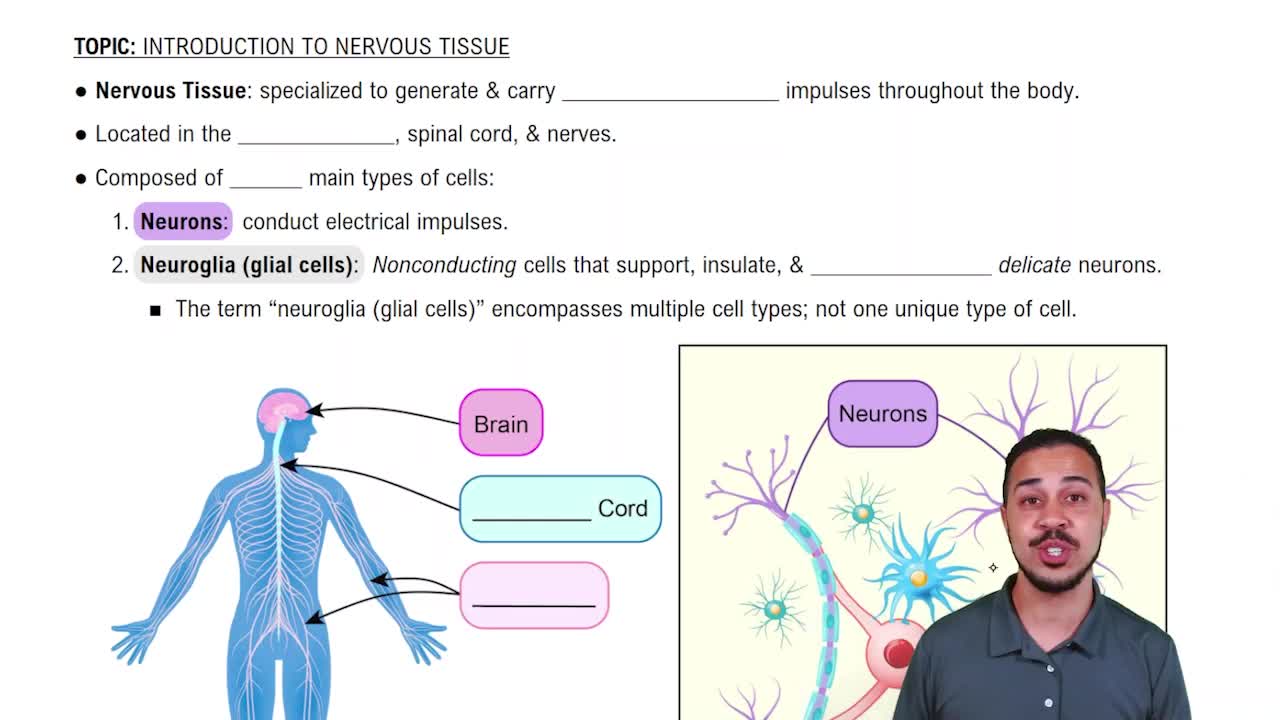
Nervous tissue is specialized for communication by transmitting electrical impulses throughout the body.
Neurons, which transmit signals, and neuroglia, which support and protect neurons.
To receive, process, and transmit electrical signals called nerve impulses.
Cell body, dendrites (receive signals), and axon (sends signals).
Dendrites receive incoming signals from other neurons or sensory receptors.
The axon transmits electrical impulses away from the cell body to other neurons or effectors.
A synapse is the junction where one neuron communicates with another cell using chemical or electrical signals.
Neuroglia are supporting cells that protect, nourish, and maintain neurons.
They provide structural support, insulation, and help maintain the environment around neurons.
A fatty layer produced by certain neuroglia that insulates axons and speeds up nerve impulse conduction.
Oligodendrocytes produce myelin in the CNS.
Schwann cells produce myelin in the PNS.
The electrical charge difference across the neuron's membrane when it is not transmitting a signal, typically around \(-70\,mV\).
A stimulus that depolarizes the membrane to a threshold level, causing a rapid change in membrane potential.
Movement of Na+ and K+ ions across the membrane generates the electrical signals of neurons.
The jumping of action potentials between nodes of Ranvier along a myelinated axon, increasing conduction speed.
Gaps in the myelin sheath where ion exchange occurs, enabling saltatory conduction.
By releasing neurotransmitters that cross the synaptic cleft and bind to receptors on the next cell.
A chemical messenger released by neurons to transmit signals across synapses.
Acetylcholine is a common neurotransmitter involved in muscle activation.