뒤로

Physiology Ch 2 Exam 1

컨트롤 버튼이 '내비게이션' 모드로 변경되었습니다.
1/34
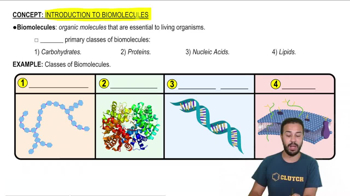
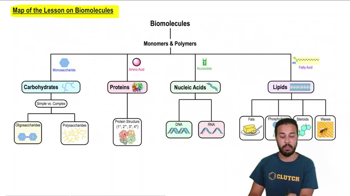
  • Four major classes of biomolecules

    Proteins (polypeptides), Carbohydrates (polysaccharides), Lipids (fats), and Nucleic Acids.
  • Monomer vs Polymer

    A monomer is the smallest unit of a macromolecule; polymers are many monomers bonded together.
  • Dehydration vs Hydrolysis reactions

    Dehydration (condensation) bonds monomers by removing water; hydrolysis breaks polymers into monomers by adding water.
  • General formula of carbohydrates

    Carbohydrates have the formula \(CH_2O\), meaning they are hydrated carbons.
  • Common carbohydrate storage forms

    Animals store carbohydrates as glycogen; plants store them as starch. Cellulose is a glucose polymer important as fiber.
  • Characteristics of lipids

    Lipids are mostly hydrophobic, not water soluble, but may have hydrophilic domains due to oxygen atoms.
  • Structure of triglycerides

    Triglycerides consist of 3 fatty acids (saturated or unsaturated) attached to a glycerol molecule; used for energy storage.
  • Phospholipid structure and function

    Phospholipids have 4 regions: polar head, phosphate group, glycerol, and 2 fatty acid tails; they are amphipathic and form bilayers in membranes.
  • Eicosanoids origin and role

    Derived from 20-carbon arachidonic acid; include prostaglandins and thromboxanes; act as cell signaling molecules.
  • Basic steroid structure

    Steroids have three 6-carbon rings and one 5-carbon ring; cholesterol is the base steroid; many steroids act as hormones.
  • Levels of protein structure

    Primary: amino acid sequence; Secondary: alpha helices and beta sheets; Tertiary: R-group interactions; Quaternary: multiple polypeptides.
  • Types of R-group interactions in tertiary protein structure

    Include hydrogen bonds, ionic bonds, hydrophobic interactions, and covalent disulfide bonds between cysteines.
  • Nucleotide components

    A nucleotide consists of a phosphate group, a pentose sugar (ribose or deoxyribose), and a nitrogenous base.
  • Five nitrogenous bases

    Purines: Adenine (A), Guanine (G); Pyrimidines: Cytosine (C), Thymine (T), Uracil (U).
  • Differences between DNA and RNA

    DNA is double-stranded with thymine (T); RNA is single-stranded with uracil (U) instead of thymine.
  • Function of the nucleus

    Contains most DNA, organizes chromosomes, synthesizes mRNA, and assembles ribosomal subunits in the nucleolus.
  • Ribosome locations and functions

    Free ribosomes make proteins for cytosol; ribosomes on rough ER make membrane or secreted proteins.
  • Smooth vs Rough Endoplasmic Reticulum

    Smooth ER synthesizes lipids, detoxifies, and stores Ca2+; Rough ER synthesizes and folds proteins with bound ribosomes.
  • Golgi complex function

    Sorts, modifies, and processes proteins received from the rough ER before transport.
  • Lysosome function and disease relevance

    Contain digestive enzymes to break down debris and bacteria; enzyme deficiencies cause diseases like Tay-Sachs.
  • Mitochondria function

    Perform cellular respiration using O2 to produce ATP, CO2, and water; involved in apoptosis and free radical generation.
  • Microtubules and motor proteins

    Microtubules are hollow rods of tubulin; kinesin moves cargo to + end, dynein moves cargo to - end; power cilia and flagella.
  • Microfilaments (actin) roles

    Provide mechanical support, determine cell shape, enable muscle contraction with myosin, and facilitate cell movement.
  • Intermediate filaments function

    Provide mechanical strength and stability; mutations can cause diseases like Lou Gehrig’s disease.
  • Tight junctions

    Seal cells together to prevent passage of substances between them; formed by occludin proteins.
  • Desmosomes

    Flexible, strong cell-cell adhesions made of cadherin proteins; allow movement while maintaining contact.
  • Gap junctions

    Channels made of connexin proteins allowing ions and small molecules to pass between cells for communication.
  • Cell cycle checkpoints

    Control points where the cell assesses readiness to proceed; regulated by internal and external signals.
  • Cause of cancer in relation to cell cycle

    Mutations in genes controlling cell cycle checkpoints cause uncontrolled cell division and tumor formation.
  • Purpose of meiosis

    Reduces chromosome number by half to produce haploid gametes with unique gene combinations via two nuclear divisions.
  • Explain the central dogma.


    The central dogma of molecular biology explains how genetic information flows through a cell:

    DNA → RNA → Protein

    1. DNA → DNA: Replication

    2. DNA → RNA: Transcription

    3. RNA → Protein: Translation

  • Explain replication


    DNA contains the cell's genetic information. Before a cell divides, it replicates (copies) its DNA so each new cell can receive a copy.

  • Explain Transcription


    The cell uses a section of DNA called a gene as a template to make messenger RNA (mRNA).

  • Explain Translation


    The mRNA travels to a ribosome, where its instructions are read to assemble amino acids into a protein. tRNA brings the appropriate amino acids to the ribosome.