 뒤로
Respiratory System - Anatomy & Physiology
 4:28

이 집합의 용어 (26)
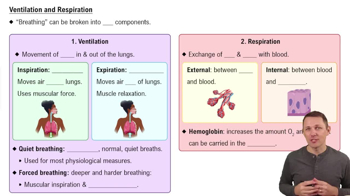
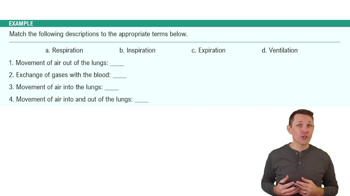
External respiration is gas exchange between lungs and blood. Internal respiration is gas exchange between blood and body tissues.
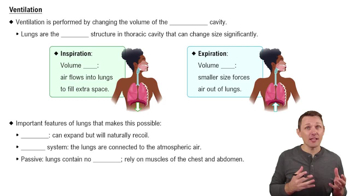
Ventilation is the process of moving air in and out of the lungs, also called breathing.
The nose, nasal cavity, sinues, and pharynx form the upper respiratory tract.
The trachea, bronchi, bronchioles larynx, and lungs form the lower respiratory tract.
The glottis is the opening between the vocal cords; the epiglottis is a flap that covers the glottis during swallowing to prevent food entry.
Trachea → Primary bronchi → Secondary bronchi → Tertiary bronchi → Bronchioles → Alveoli
The right lung has 3 lobes and is shorter; the left lung has 2 lobes and a cardiac notch to accommodate the heart.
Visceral pleura covers the lungs; parietal pleura lines the thoracic cavity. They reduce friction and create a pressure gradient for lung expansion.
During quiet inspiration, the diaphragm and external intercostal muscles contract to expand the thoracic cavity.
Quiet expiration is passive. Forceful expiration uses internal intercostal muscles and abdominal muscles to decrease thoracic volume.
Tidal volume is the amount of air inhaled or exhaled during normal, quiet breathing.
Inspiratory reserve volume is the extra air that can be inhaled forcefully after a normal inspiration.
Expiratory reserve volume is the extra air that can be forcefully exhaled after a normal expiration.
Residual volume is the air remaining in the lungs after forceful expiration, preventing lung collapse.
Vital capacity = TV + IRV + ERV; it is the total air that can be exhaled after maximum inhalation.
Inspiratory capacity = TV + IRV; the maximum air inhaled after a normal exhalation.
Functional residual capacity = ERV + RV; the air remaining in lungs after normal expiration.
Total lung capacity = TV + IRV + ERV + RV; the total volume of air lungs can hold.
Alveoli are tiny air sacs where gas exchange occurs. The respiratory membrane consists of alveolar epithelium, capillary endothelium, and their fused basement membranes.
Surfactant reduces surface tension in alveoli, preventing collapse and aiding lung expansion.
About 98.5% of oxygen binds to hemoglobin; 1.5% is dissolved in plasma.
~70% as bicarbonate ions, 23% bound to hemoglobin, and 7% dissolved in plasma.
Increased CO2 lowers blood pH, stimulating respiratory centers to increase ventilation and restore balance.
\(\mathrm{CO_2 + H_2O \leftrightarrow H_2CO_3 \leftrightarrow H^+ + HCO_3^-}\). Most CO2 is transported as bicarbonate for efficient removal.
Transporting CO2 as bicarbonate allows greater CO2 capacity and maintains blood pH balance.
Respiratory centers are in the medulla oblongata and pons, controlling rhythm and depth of breathing.