 뒤로
Respiratory System Anatomy & Physiology
 4:28

이 집합의 용어 (23)
The nose is the main external opening for the respiratory system. It filters, warms, and moistens air and houses olfactory receptors.
Paranasal sinuses lighten the skull, produce mucus, and help warm and moisten inhaled air.
The pharynx serves as a passageway for air and food; it connects the nasal cavity to the larynx and esophagus.
Includes mucus production, cilia movement, coughing, sneezing, and reflexes to trap and expel particles.
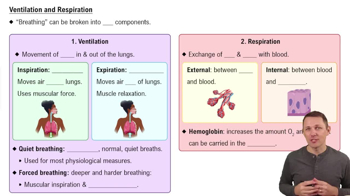
The conducting zone transports air; the respiratory zone is where gas exchange occurs (alveoli).
The larynx contains vocal cords, routes air and food, and protects the airway during swallowing.
The trachea is a rigid tube that conducts air to the bronchi and is lined with ciliated mucosa to trap debris.
Bronchi branch from the trachea to deliver air to each lung and further divide into bronchioles.
The respiratory membrane consists of alveolar and capillary walls and their fused basement membranes, allowing efficient gas exchange.
Nose → pharynx → larynx → trachea → bronchi → bronchioles → alveolar ducts → alveoli.
Lungs are paired organs with lobes; the pleurae are serous membranes that reduce friction and create a pressure gradient.
The partial vacuum in the intrapleural space keeps lungs inflated by preventing lung collapse.
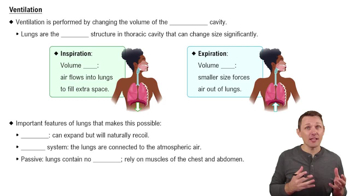
Boyle’s law: Pressure and volume are inversely related; lung volume changes cause pressure changes that drive air flow.
Diaphragm and intercostal muscles change thoracic volume, enabling inspiration and expiration.
Include airway resistance, lung compliance, and surface tension of alveolar fluid.
Dead space is the volume of air in conducting passages that does not participate in gas exchange.
Includes tidal volume, inspiratory reserve, expiratory reserve, residual volume, and combinations like vital capacity.
In a gas mixture, each gas exerts pressure proportional to its concentration.
The amount of gas dissolved in a liquid is proportional to its partial pressure and solubility.
Alveolar air has higher CO2 and water vapor, and lower O2 due to gas exchange and humidification.
Oxygen is mostly bound to hemoglobin in red blood cells; a small amount is dissolved in plasma.
PO2, temperature, pH, BPG, and PCO2 influence hemoglobin’s oxygen affinity.
CO2 is transported as bicarbonate ions, bound to hemoglobin, and dissolved in plasma.