 뒤로
Respiratory System - Anatomy & Physiology
 4:28

이 집합의 용어 (31)
Gas exchange, olfaction, and speech.
Nose, sinuses, and pharynx.
Larynx, trachea, bronchi, and lungs.
Provide an airway, moisten and warm air, filter particles, act as a resonating chamber, and contain olfactory receptors.
Increase surface area in the nasal cavity to enhance air warming and filtering.
Lighten the skull, warm and moisten air, and secrete mucus.
Nasopharynx (airway), oropharynx (food and air), laryngopharynx (food and air).
Palatine, lingual, pharyngeal, and tubal tonsils.
Maintain an open airway, route air and food, and enable voice production.
Nine cartilages: eight hyaline and one elastic (epiglottis).
True vocal cords produce sound; false vocal cords protect the airway.
Mucosa (with goblet cells), submucosa (seromucous glands), and adventitia (connective tissue).
Destroys cilia, impairing mucus clearance; recovery possible after cessation.
23 generations of branches; conducting zone leads to respiratory zone where gas exchange occurs.
About 300 million alveoli; site of gas exchange; surrounded by elastic fibers and capillaries.
Reduces surface tension in alveoli to prevent collapse; deficiency causes infant respiratory distress syndrome.
Apex, base, hilum, lobes (right: 3, left: 2), bronchopulmonary segments, and lobules.
Pulmonary arteries carry deoxygenated blood; pulmonary veins carry oxygenated blood; bronchial arteries supply systemic blood.
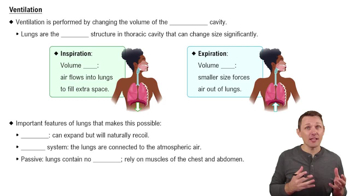
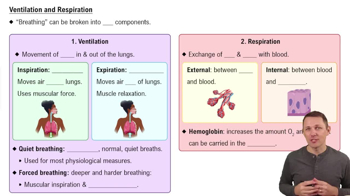
Inspiration: diaphragm and intercostals contract, increasing thoracic volume.
Expiration: muscles relax, decreasing thoracic volume.
Pressure of a gas varies inversely with its volume: \(P \times V = \text{constant}\).
Amount of air moved in or out during normal breathing.
Air forcibly inspired beyond tidal volume.
Air forcibly expired beyond tidal volume.
Air remaining in lungs after maximal expiration.
Combinations of pulmonary volumes, e.g., Inspiratory Capacity = TV + IRV.
Measures forced vital capacity (FVC) and forced expiratory volume (FEV1) to distinguish obstructive vs. restrictive lung diseases.
Total pressure of a gas mixture equals the sum of the partial pressures of individual gases: \(P_{total} = P_1 + P_2 + ...\).
Gas dissolves in liquid proportional to its partial pressure and solubility.
Decreased pH and increased PCO2 reduce hemoglobin's affinity for oxygen, enhancing oxygen release to tissues.
7-10% dissolved in plasma, ~20% bound to hemoglobin, ~70% as bicarbonate.
Anemic, ischemic, histotoxic, and hypoxemic hypoxia.