Skip to main content
Anatomy & Physiology
나의 코스
배우기
시험 준비
AI 튜터
학습 가이드
교과서적 해결책
플래시카드
탐험해 보세요
앱을 사용해 보세요
나의 코스
배우기
시험 준비
AI 튜터
학습 가이드
교과서적 해결책
플래시카드
탐험해 보세요
앱을 사용해 보세요
뒤로
Respiratory System Physiology - Anatomy & Physiology
카드를 뒤집기 위해 탭할 수 있습니다.
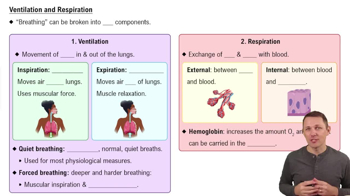
Phases of pulmonary ventilation
카드를 뒤집기 위해 탭할 수 있습니다.
👆
Phases of pulmonary ventilation
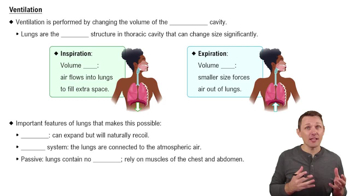
Inspiration
: gases flow into lungs;
Expiration
: gases exit lungs.
진행 상황 추적
컨트롤 버튼이 '내비게이션' 모드로 변경되었습니다.
1/30
추천 영상
VideoThumbView.guidedCourse
4:28
Ventilation
8378
views
195
rank
1
comments
VideoThumbView.guidedCourse
5:55
Ventilation and Respiration
12337
views
366
rank
1
comments
VideoThumbView.guidedCourse
1:37
Introduction to Lung Physiology Example 1
8387
views
223
rank
1
comments
이 집합의 용어 (30)
하이드의 정의
Phases of pulmonary ventilation
Inspiration
: gases flow into lungs;
Expiration
: gases exit lungs.
Atmospheric pressure (Patm)
Pressure exerted by air surrounding the body; 760 mm Hg at sea level equals 1 atmosphere.
Intrapulmonary pressure (Ppul)
Pressure inside alveoli; fluctuates with breathing and eventually equals atmospheric pressure.
Intrapleural pressure (Pip)
Pressure in pleural cavity; always negative, usually 4 mm Hg less than Ppul, prevents lung collapse.
Forces promoting lung collapse
1) Elastic recoil of lungs; 2) Surface tension of alveolar fluid pulling alveoli smaller.
Force opposing lung collapse
Elasticity of chest wall pulling thorax outward, maintaining negative intrapleural pressure.
Transpulmonary pressure
Difference between intrapulmonary and intrapleural pressure (\(P_{pul} - P_{ip}\)); keeps lungs open.
Atelectasis
Lung collapse caused by plugged bronchioles or pneumothorax; treated by removing air with chest tubes.
Boyle's law in pulmonary ventilation
Pressure of a gas varies inversely with volume: \(P_1V_1 = P_2V_2\).
Muscles involved in inspiration
Diaphragm (contracts and flattens) and external intercostals (lift rib cage) increase thoracic volume.
Pressure changes during inspiration
Intrapulmonary pressure drops below atmospheric pressure, causing air to flow into lungs.
Forced inspiration muscles
Accessory muscles: scalenes, sternocleidomastoid, pectoralis minor, and erector spinae increase thoracic cage size.
Expiration process
Usually passive; inspiratory muscles relax, thoracic volume decreases, intrapulmonary pressure rises above atmospheric, air flows out.
Forced expiration muscles
Oblique and transverse abdominal muscles and internal intercostals actively decrease thoracic volume.
Airway resistance and gas flow relationship
Gas flow (F) is proportional to pressure difference (∆P) and inversely proportional to resistance (R): \(F = \frac{\Delta P}{R}\).
Alveolar surface tension
Attraction of liquid molecules in alveoli that tends to collapse alveoli; reduced by surfactant.
Surfactant
Detergent-like lipid-protein complex produced by type II alveolar cells; reduces surface tension and prevents alveolar collapse.
Lung compliance
Measure of lung stretchability; higher compliance means easier lung expansion.
Lung compliance formula
\(C_L = \frac{\Delta V_L}{\Delta (P_{pul} - P_{ip})}\), where
CL
is compliance,
ΔVL
is change in lung volume.
Respiratory volumes: Tidal volume (TV)
Amount of air moved in and out of lungs with each breath; averages about 500 ml.
Inspiratory reserve volume (IRV)
Amount of air that can be forcibly inspired beyond tidal volume (2100–3200 ml).
Expiratory reserve volume (ERV)
Amount of air that can be forcibly expelled from lungs (1000–1200 ml).
Residual volume (RV)
Amount of air remaining in lungs after forced expiration; keeps alveoli open.
Vital capacity (VC)
Sum of tidal volume, inspiratory reserve volume, and expiratory reserve volume (TV + IRV + ERV).
Anatomical dead space
Air in conducting passages (~150 ml) that does not participate in gas exchange.
Dalton's law of partial pressures
Total pressure of gas mixture equals sum of partial pressures of individual gases.
Henry's law
Gas dissolves in liquid proportional to its partial pressure; solubility and temperature affect amount dissolved.
External respiration
Gas exchange between alveoli and blood influenced by partial pressure gradients, membrane thickness, and ventilation-perfusion coupling.
Ventilation-perfusion coupling
Matching of alveolar ventilation and pulmonary blood flow controlled by local PO2 and PCO2 affecting arteriole and bronchiole diameters.
Internal respiration
Gas exchange between blood and body tissues; oxygen moves from blood to tissues, CO2 moves from tissues to blood.
 뒤로뒤로
 4:28