 뒤로
Respiratory Volumes and Capacities
 6:38

이 집합의 용어 (21)
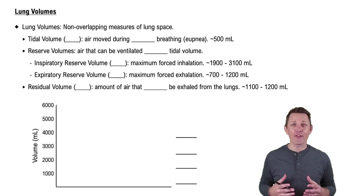
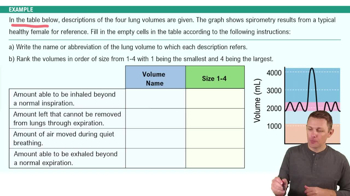
Tidal Volume (TV) is the amount of air inhaled or exhaled during normal, quiet breathing, typically about 0.5 liters.
Inspiratory Reserve Volume (IRV) is the extra air you can inhale after a normal inspiration, about 1.9 L for females and 3.1 L for males.
Expiratory Reserve Volume (ERV) is the extra air you can exhale after a normal exhalation, approximately 0.7 L for females and 1.2 L for males.
Residual Volume (RV) is the air left in the lungs after maximal exhalation, about 1.1 L for females and 1.2 L for males; it cannot be exhaled.
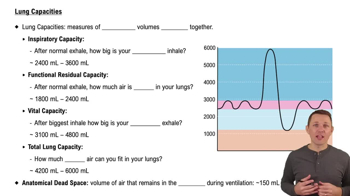
Inspiratory Capacity (IC) is the maximum air you can inhale after a normal exhale, calculated as IC = TV + IRV.
Functional Residual Capacity (FRC) is the air left in lungs after a normal exhale, calculated as FRC = ERV + RV.
Vital Capacity (VC) is the maximum air you can exhale after a maximum inhale, calculated as VC = IRV + TV + ERV.
Total Lung Capacity (TLC) is the total air the lungs can hold, calculated as TLC = IRV + TV + ERV + RV.
About 0.5 liters during normal, quiet breathing.
Approximately 1.9 L for females and 3.1 L for males.
Approximately 0.7 L for females and 1.2 L for males.
Approximately 1.1 L for females and 1.2 L for males.
About 2.4 L for females and 3.6 L for males.
About 1.8 L for females and 2.4 L for males.
About 3.1 L for females and 4.8 L for males.
About 4.2 L for females and 6.0 L for males.
Anatomical Dead Space is about 0.15 liters of air in the airways that does not participate in gas exchange.
IC = TV + IRV
FRC = ERV + RV
VC = IRV + TV + ERV
TLC = IRV + TV + ERV + RV