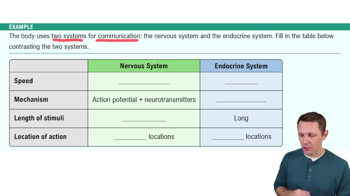
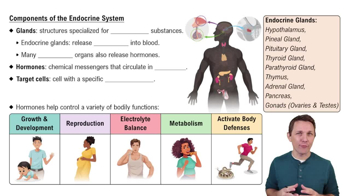
Endocrine glands produce hormones released into the blood and are ductless. Exocrine glands produce non-hormonal substances like sweat and have ducts to carry secretions to membrane surfaces.
Three types of chemical messengers
1. Hormones: long-distance signals traveling in blood or lymph. 2. Autocrines: act on the same cell that secretes them. 3. Paracrines: act locally on nearby cells.
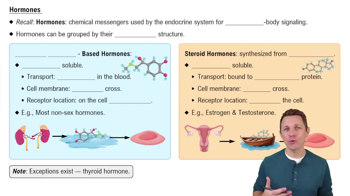
Two main classes of hormones by chemical composition
1. Amino acid-based hormones (water soluble): amino acid derivatives, peptides, proteins. 2. Steroids (lipid soluble): synthesized from cholesterol, including gonadal and adrenocortical hormones.
How do hormones affect target cells?
Hormones alter cell activity by changing membrane permeability, stimulating enzyme/protein synthesis, activating/deactivating enzymes, inducing secretion, or stimulating mitosis.
Mechanism of action for water-soluble hormones
Bind to plasma membrane receptors, activate G protein, which activates adenylate cyclase to convert ATP to cAMP, the second messenger that activates protein kinases.
Mechanism of action for lipid-soluble hormones
Diffuse into target cells, bind intracellular receptors, receptor-hormone complex enters nucleus, binds DNA, initiates transcription and protein synthesis.
Three stimuli that control hormone release
1. Humoral stimulus: changes in blood levels of ions/nutrients. 2. Neural stimulus: nerve fibers stimulate hormone release. 3. Hormonal stimulus: hormones stimulate other endocrine glands.
Factors affecting activation of target cells by hormones
Blood hormone levels, number of receptors (up-regulation/down-regulation), and binding affinity between hormone and receptor.
Types of hormone interactions at target cells
Permissiveness: one hormone needs another to act fully. Synergism: combined effect greater than alone. Antagonism: one hormone opposes another.
Role of hypothalamus in pituitary relationships
Hypothalamus produces ADH and oxytocin transported to posterior pituitary for storage and release; secretes releasing/inhibiting hormones to anterior pituitary via portal system.
Negative vs positive feedback in hormone regulation
Negative feedback reduces original stimulus to maintain balance. Positive feedback amplifies the stimulus, e.g., oxytocin during labor.
Function of oxytocin
Stimulates uterine contractions during labor and milk ejection; promotes affection and well-being feelings.
Function of antidiuretic hormone (ADH)
Reduces urine production and increases urine concentration by promoting water reabsorption in kidneys.
Follicular cells produce thyroglobulin; iodide oxidized to iodine; iodine attaches to thyroglobulin forming MIT and DIT; MIT and DIT combine to form T3 and T4; hormones released into blood.
Parathyroid hormone (PTH) functions
Increases blood calcium by activating osteoclasts, enhancing kidney calcium reabsorption, and promoting vitamin D activation for intestinal calcium absorption.
Zones and hormones of adrenal cortex
Zona glomerulosa: mineralocorticoids (aldosterone). Zona fasciculata: glucocorticoids (cortisol). Zona reticularis: gonadocorticoids (androgens).
Regulation and function of aldosterone
Released in response to low blood pressure or high potassium; increases sodium retention and potassium excretion in kidneys, raising blood volume and pressure.
Metabolic effects of cortisol
Promotes gluconeogenesis, glycogenolysis, fat mobilization, and protein catabolism to increase blood glucose and fuel availability.
Short-term stress response hormones and effects
Sympathetic stimulation causes adrenal medulla to release epinephrine and norepinephrine, increasing heart rate, vasoconstriction, bronchodilation, and blood glucose.
Long-term stress response (HPA axis)
Hypothalamus releases CRH → anterior pituitary releases ACTH → adrenal cortex releases cortisol and aldosterone, promoting energy mobilization and fluid retention.
Pancreas exocrine vs endocrine functions
Exocrine: acinar cells secrete digestive enzymes into ducts. Endocrine: pancreatic islets produce glucagon (alpha cells) and insulin (beta cells).
Insulin effects on blood glucose
Promotes glucose uptake by cells, glycogenesis, lipogenesis, protein synthesis, and inhibits glycogenolysis and gluconeogenesis; lowers blood glucose.
Glucagon effects on blood glucose
Stimulates glycogenolysis, gluconeogenesis, and glucose release by the liver; raises blood glucose levels.
Role of thymus in endocrine system
Releases thymic hormones that act as paracrines to facilitate T lymphocyte development for immune function.
 뒤로
 7:06