Binding of antigens to receptors of immunocompetent lymphocytes leads to clonal selection. Describe the process of clonal selection. What nonlymphocyte cell is a central actor in this process, and what is its function?
Ch. 12 The Lymphatic System and Body Defenses

12장, 문제 16
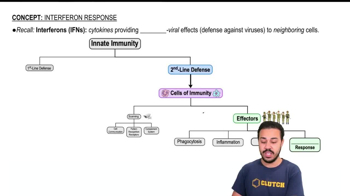
Interferons are referred to as antiviral proteins. What stimulates their production, and how do they protect uninfected cells?
검증된 단계별 안내1
Understand that interferons are a type of cytokine, which are signaling proteins produced by cells in response to specific stimuli, particularly viral infections.
Recognize that the production of interferons is stimulated when a cell detects the presence of viral components, such as double-stranded RNA or viral proteins, which are foreign to the host cell.
Learn that once produced, interferons bind to receptors on neighboring uninfected cells, triggering a signaling cascade that activates antiviral defense mechanisms within those cells.
Explore how interferons stimulate the production of antiviral proteins, such as protein kinase R (PKR), which inhibits viral replication by interfering with the translation of viral RNA.
Understand that interferons also enhance the activity of immune cells, such as natural killer (NK) cells and macrophages, to destroy infected cells and prevent the spread of the virus.

비슷한 문제에 대한 검증된 영상 답변:
이 영상 해법은 위 문제에 도움이 된다고 튜터들이 추천한 것입니다.
영상 길이:
3m주요 개념
질문에 올바르게 답하기 위해 반드시 이해해야 하는 핵심 개념들은 다음과 같습니다.
Interferons
Interferons are a group of signaling proteins produced by host cells in response to viral infections. They play a crucial role in the immune response by signaling neighboring cells to enhance their antiviral defenses. There are three main types: Type I (e.g., IFN-alpha and IFN-beta), Type II (IFN-gamma), and Type III (IFN-lambda), each with distinct functions in immune regulation.
추천 영상:
가이드 코스
Interferons
Stimuli for Interferon Production
The production of interferons is primarily stimulated by the presence of viral components, such as double-stranded RNA, which is often produced during viral replication. Other stimuli include certain cytokines and pathogen-associated molecular patterns (PAMPs) recognized by pattern recognition receptors (PRRs) on host cells. This recognition triggers signaling pathways that lead to the transcription of interferon genes.
추천 영상:
가이드 코스
Interferons
Mechanism of Action
Interferons protect uninfected cells by binding to specific receptors on their surface, initiating a signaling cascade that activates genes responsible for antiviral defenses. This results in the production of proteins that inhibit viral replication, enhance the immune response, and promote apoptosis in infected cells. Consequently, interferons create an antiviral state in neighboring cells, limiting the spread of the virus.
추천 영상:
Action Potential
관련 실천
교과서 질문
1093
views
1
rank
교과서 질문
Compare and contrast blood, interstitial fluid, and lymph.
1465
views
교과서 질문
The main cellular target of the HIV virus that causes AIDS is
a. Helper T cells
b. Cytotoxic T cells
c. Macrophages
d. B cells
42
views
교과서 질문
Describe the specific roles of helper, cytotoxic, and regulatory T cells in cell-mediated immunity. Which is thought to be disabled in AIDS?
65
views
교과서 질문
What is complement? Besides bacterial lysis, what are some of the roles of complement?
1396
views
교과서 질문
Name the five classes of immunoglobulins. Which is most likely to be found attached to a B cell membrane? Which is most abundant in plasma? Which is important in allergic responses? Which is the first Ig to be released during the primary response? Which can cross the placental barrier?
1281
views