Ch. 19 Blood
Martini - Fundamentals of Anatomy & Physiology 11th Edition
Martini, Nath, Bartholomew11th EditionFundamentals of Anatomy & PhysiologyISBN: 9780136874089당신이 사용하는 게 아니라요?교과서 변경
19장, 문제 7

The following is a list of the phases involved in the process of hemostasis:


  1. Coagulation
  2. Fibrinolysis
  3. Vascular spasm
  4. Retraction
  5. Platelet phase
The correct sequence of these phases is:
(a) 5, 1, 4, 2, 3
(b) 3, 5, 1, 4, 2
(c) 2, 3, 5, 1, 4
(d) 3, 5, 4, 1, 2
(e) 4, 3, 5, 2, 1

검증된 단계별 안내
1
Step 1: Understand the process of hemostasis, which is the body's mechanism to stop bleeding and involves several phases occurring in a specific order.
Step 2: Identify the initial phase, which is the vascular spasm (vasoconstriction) that reduces blood flow immediately after vessel injury.
Step 3: Recognize that the platelet phase follows, where platelets adhere to the damaged vessel wall and aggregate to form a temporary plug.
Step 4: Next is the coagulation phase, where a complex cascade leads to the formation of fibrin strands that stabilize the platelet plug, creating a more permanent clot.
Step 5: After clot formation, retraction occurs, which tightens the clot and brings the edges of the damaged vessel closer together, followed by fibrinolysis, the process that breaks down the clot once healing is complete.

비슷한 문제에 대한 검증된 영상 답변:

이 영상 해법은 위 문제에 도움이 된다고 튜터들이 추천한 것입니다.

주요 개념

질문에 올바르게 답하기 위해 반드시 이해해야 하는 핵심 개념들은 다음과 같습니다.

Phases of Hemostasis

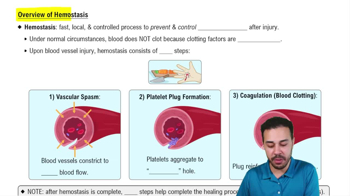
Hemostasis is the body's process to stop bleeding and involves several sequential phases: vascular spasm, platelet phase, coagulation, retraction, and fibrinolysis. Each phase plays a specific role, from immediate vessel constriction to clot formation and eventual clot removal.
추천 영상:
가이드 코스
4:28
Overview of Hemostasis

Vascular Spasm and Platelet Phase

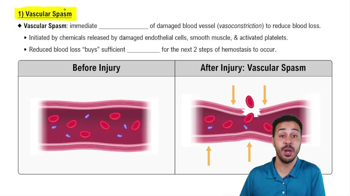
Vascular spasm is the initial response where blood vessels constrict to reduce blood flow. This is followed by the platelet phase, where platelets adhere to the injury site, forming a temporary plug to prevent further bleeding.
추천 영상:
가이드 코스
3:18
Vascular Spasm

Coagulation, Retraction, and Fibrinolysis

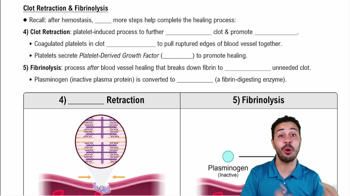
Coagulation stabilizes the platelet plug by forming a fibrin mesh, creating a stable clot. Retraction then tightens the clot to bring wound edges closer. Finally, fibrinolysis dissolves the clot once healing is complete, restoring normal blood flow.
추천 영상:
가이드 코스
7:16
Clot Retraction & Fibrinolysis