Ch. 20 The Heart
Martini - Fundamentals of Anatomy & Physiology 11th Edition
Martini, Nath, Bartholomew11th EditionFundamentals of Anatomy & PhysiologyISBN: 9780136874089당신이 사용하는 게 아니라요?교과서 변경
20장, 문제 6

The cardiac skeleton of the heart has which two of the following functions?
(a) It physically isolates the muscle fibers of the atria from those of the ventricles.
(b) It maintains the normal shape of the heart.
(c) It helps distribute the forces of cardiac contraction.
(d) It allows more rapid contraction of the ventricles.
(e) It strengthens and helps prevent overexpansion of the heart.

검증된 단계별 안내
1
Step 1: Understand the cardiac skeleton's anatomical role. The cardiac skeleton is a dense connective tissue structure located between the atria and ventricles of the heart.
Step 2: Recognize that one of its primary functions is to physically separate the atrial muscle fibers from the ventricular muscle fibers, which helps prevent unwanted electrical conduction between these chambers. This corresponds to option (a).
Step 3: Consider the structural support role of the cardiac skeleton. It provides a framework that maintains the shape of the heart and anchors the heart valves, contributing to the heart's mechanical stability. This relates to options (b) and (e).
Step 4: Evaluate the options related to electrical conduction and contraction speed. The cardiac skeleton does not facilitate more rapid contraction of the ventricles (option d), nor is its main role to distribute contraction forces (option c), although it indirectly supports force transmission by providing structural integrity.
Step 5: Conclude that the two main functions of the cardiac skeleton are (a) physically isolating atrial and ventricular muscle fibers to control electrical conduction, and (e) strengthening and preventing overexpansion of the heart by providing structural support.

비슷한 문제에 대한 검증된 영상 답변:

이 영상 해법은 위 문제에 도움이 된다고 튜터들이 추천한 것입니다.

주요 개념

질문에 올바르게 답하기 위해 반드시 이해해야 하는 핵심 개념들은 다음과 같습니다.

Cardiac Skeleton Structure and Composition

The cardiac skeleton is a dense connective tissue framework within the heart that provides structural support. It surrounds the heart valves and separates the atria from the ventricles, forming a fibrous ring that anchors valve leaflets and muscle fibers.
추천 영상:
9:44
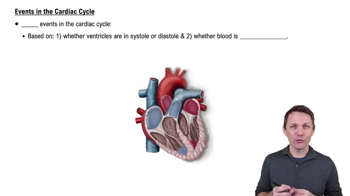
Events in the Cardiac Cycle

Electrical Isolation Between Atria and Ventricles

One key function of the cardiac skeleton is to electrically isolate the atrial muscle fibers from the ventricular muscle fibers. This prevents direct electrical conduction between chambers, ensuring that impulses pass only through the atrioventricular node, coordinating proper heart rhythm.
추천 영상:
3:42
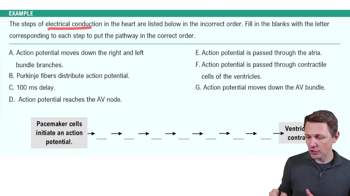
Electrical Conduction System of the Heart Example 2

Mechanical Support and Force Distribution

The cardiac skeleton maintains the shape of the heart and provides mechanical support by distributing the forces generated during cardiac contraction. This prevents overexpansion and helps maintain the integrity of the heart valves and chambers during the cardiac cycle.
추천 영상:
3:43
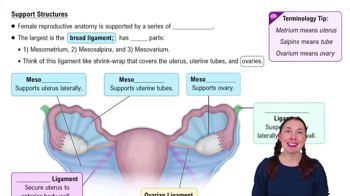
Support Structures