Skip to main content
General Biology
나의 코스
배우기
시험 준비
AI 튜터
학습 가이드
교과서적 해결책
플래시카드
탐험해 보세요
앱을 사용해 보세요
나의 코스
배우기
시험 준비
AI 튜터
학습 가이드
교과서적 해결책
플래시카드
탐험해 보세요
앱을 사용해 보세요
뒤로
History of Life on Earth exam
카드를 뒤집기 위해 탭할 수 있습니다.
Plate Tectonics
카드를 뒤집기 위해 탭할 수 있습니다.
👆
Plate Tectonics
The theory that Earth's crust is divided into large solid plates that float on the hot inner mantle.
진행 상황 추적
컨트롤 버튼이 '내비게이션' 모드로 변경되었습니다.
1/28
관련 플래시카드
관련 실천
추천 영상
History of Life on Earth definitions
History of Life on Earth
15 용어
History of Life on Earth quiz #1
History of Life on Earth
12 용어
History of Life on Earth quiz #2
History of Life on Earth
9 용어
History of Life on Earth
24. History of Life on Earth
5 문제점
주제
Jason
Extinctions
24. History of Life on Earth
5 문제점
주제
24. History of Life on Earth - Part 1 of 2
4 주제
10 문제점
장
Jason
24. History of Life on Earth - Part 2 of 2
2 주제
5 문제점
장
VideoThumbView.guidedCourse
04:53
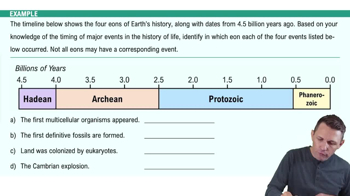
History of Life on Earth Example 1
2365
views
27
rank
VideoThumbView.guidedCourse
07:18
Geologic Record
2970
views
32
rank
이 집합의 용어 (28)
하이드의 정의
Plate Tectonics
The theory that Earth's crust is divided into large solid plates that float on the hot inner mantle.
What is continental drift?
The movement of tectonic plates resulting in the shifting of continents over time.
Biogeography
The study of the distribution of species and ecosystems in geographic space and through geological time.
What is the fossil record?
A collection of fossils that provides a historical snapshot of life on Earth, though it is biased and incomplete.
Stromatolites
The oldest known fossils, formed by photosynthetic cyanobacteria, still existing today.
What is a mass extinction?
A period where the majority of species die out in a relatively short time, reshaping life on Earth.
Adaptive Radiation
The process by which organisms rapidly diversify into new forms, often following environmental changes.
What was the Cambrian Explosion?
A period of rapid evolutionary diversification around 541 million years ago.
Symbiogenesis
The process where two separate life forms fuse to create a new life form, also known as endosymbiont theory.
What is radiocarbon dating?
A method for determining the age of fossils by comparing the ratio of carbon-12 to carbon-14.
Half-Life
The time it takes for half of a sample of a radioactive substance to decay.
What is punctuated equilibrium?
The theory that evolutionary changes occur rapidly during short periods, punctuating long periods of little change.
Precambrian Time
The period from Earth's formation to the appearance of most animal groups, dominated by unicellular life.
Phanerozoic Era
The current geological era, starting with the Cambrian Explosion and including the rise of multicellular life.
What are gymnosperms?
A group of seed-producing plants, including conifers, that were dominant during the Mesozoic era.
Angiosperms
Flowering plants that became dominant during the Cenozoic era.
What is the significance of the Galapagos finches?
They are an example of adaptive radiation, where finches evolved into different forms due to varying environmental pressures.
Laurasia and Gondwana
The two large landmasses that formed from the breakup of the supercontinent Pangaea.
What is the Great Dying?
The largest mass extinction event, occurring at the end of the Permian period.
Eukaryotes
Organisms with complex cells that have a nucleus, formed through symbiogenesis.
What is the significance of oxygen in Earth's history?
Oxygen was absent in early Earth's atmosphere and became abundant due to photosynthetic processes, influencing the size and complexity of life.
Mesozoic Era
The era dominated by dinosaurs and gymnosperms, ending with a mass extinction.
Cenozoic Era
The current era, marked by the dominance of mammals and angiosperms.
What is the significance of the Cambrian Explosion?
It marks the rapid diversification of life forms and the beginning of the Phanerozoic era.
Endosymbiont Theory
The theory that eukaryotic cells originated through a symbiotic relationship between different species of prokaryotes.
What is exponential decay?
A process where the quantity of a substance decreases at a rate proportional to its current value, as seen in radioactive decay.
Pangaea
A supercontinent that existed during the late Paleozoic and early Mesozoic eras, later breaking apart due to continental drift.
What is the role of cyanobacteria in stromatolites?
Cyanobacteria form stromatolites through their photosynthetic processes, creating layered structures.
 뒤로뒤로

 04:53