 뒤로
3-General Biology: Nervous System and Related Concepts
 12:47

이 집합의 용어 (16)
The Peripheral Nervous System consists of nerves outside the brain and spinal cord that connect the central nervous system to limbs and organs.
The Central Nervous System includes the brain and spinal cord, responsible for processing and sending out neural signals.
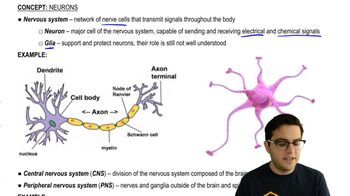
A neuron has a cell body, dendrites that receive signals, and an axon that transmits impulses.
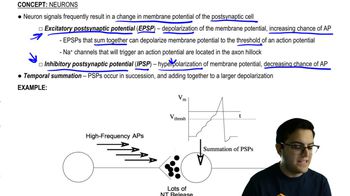
An action potential is an electrical impulse that travels along a neuron, caused by rapid changes in membrane voltage.
Neurons conduct impulses by depolarization and repolarization along the axon, transmitting signals to other neurons via neurotransmitters.
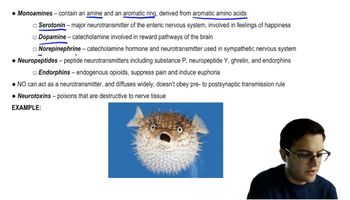
Neurotransmitters are chemicals released at synapses to transmit signals between neurons or to muscles.
Neurons include sensory neurons (carry signals to CNS), motor neurons (carry signals from CNS), and interneurons (connect neurons within CNS).
Glial cells support neurons by providing nutrients, insulation (myelin), and maintaining homeostasis.
The brain includes the cerebrum (thought, movement), cerebellum (balance), and brainstem (basic life functions).
The dopaminergic reward system involves brain areas that release dopamine to reinforce rewarding behaviors.
Dopamine release in response to rewards motivates behavior by creating feelings of pleasure and reinforcement.
It promotes survival by encouraging behaviors like eating and reproduction through positive reinforcement.
Oxytocin stimulates uterine contractions during childbirth and milk release during lactation.
Oxytocin promotes social bonding and trust in animals and humans.
Gut microbes can influence depression symptoms via hormones, neurotransmitters, and metabolites affecting brain function.
Depression involves multiple body systems; treating it effectively requires addressing interactions among these systems.