Skip to main content
General Biology
나의 코스
배우기
시험 준비
AI 튜터
학습 가이드
교과서적 해결책
플래시카드
탐험해 보세요
앱을 사용해 보세요
나의 코스
배우기
시험 준비
AI 튜터
학습 가이드
교과서적 해결책
플래시카드
탐험해 보세요
앱을 사용해 보세요
뒤로
Animal Tissue Types and Histology (lab 7 histology exam)
카드를 뒤집기 위해 탭할 수 있습니다.
What are the four major types of animal tissues?
카드를 뒤집기 위해 탭할 수 있습니다.
👆
What are the four major types of animal tissues?
Nervous, muscle, epithelial, and connective tissues
are the four major types of animal tissues.
진행 상황 추적
컨트롤 버튼이 '내비게이션' 모드로 변경되었습니다.
1/30
추천 영상
03:16
Muscle and Epithelial Tissues
3781
views
36
rank
1
comments
05:37
Tissues and Organs
3909
views
41
rank
10:26
Animal Physiology and Fitness Trade-Offs
4620
views
62
rank
1
comments
이 집합의 용어 (30)
하이드의 정의
What are the four major types of animal tissues?
Nervous, muscle, epithelial, and connective tissues
are the four major types of animal tissues.
Primary function of nervous tissue
Communication
through neurons that transmit electrical impulses.
Primary function of muscle tissue
Contraction to produce movement
, either voluntary or involuntary.
Primary functions of epithelial tissue
Covers body surfaces and lines cavities for
protection, absorption, and secretion
.
Primary functions of connective tissue
Provides
support, structure, defense, transportation, and storage
.
How is epithelial tissue classified by layers?
Simple epithelium
has one cell layer;
stratified epithelium
has multiple layers.
How is epithelial tissue classified by cell shape?
Cells can be
squamous (flat), cuboidal (cube-shaped), or columnar (tall and rectangular)
.
Function and location of simple squamous epithelium
Allows
diffusion and filtration
; found in
lungs, kidneys, blood vessels, and body cavities
.
Function and location of simple cuboidal epithelium
Specialized for
secretion and absorption
; located in
kidney tubules and gland ducts
.
Function and location of simple columnar epithelium
Involved in
secretion (mucus) and absorption
; found in
digestive tract and female reproductive system
.
What distinguishes stratified squamous epithelium?
Multiple layers with top cells
flattened (squamous)
; can be
keratinized (dry) or non-keratinized (moist)
.
Function and location of keratinized stratified squamous epithelium
Protects against
abrasion and drying
; found in
skin epidermis
.
Function and location of non-keratinized stratified squamous epithelium
Protects underlying tissue in
moist areas
; found in
mouth, esophagus, vagina
.
What is pseudostratified columnar epithelium?
Single layer of cells with nuclei at different levels, giving a
false layered appearance
.
Function and location of ciliated pseudostratified columnar epithelium
Secretes mucus and moves it with cilia; found in
trachea and upper respiratory tract
.
Effect of smoking on respiratory cilia
Chemicals in smoke
destroy cilia
, leading to impaired mucus clearance and
smoker's cough
.
Components and function of connective tissue
Cells scattered in a
protein matrix
; functions include
support, protection, storage, and transport
.
Characteristics of loose areolar connective tissue
Loose fiber matrix with fibroblasts;
wraps and cushions organs
, found under skin and lining cavities.
Characteristics and function of dense regular connective tissue
Parallel collagen fibers; forms
tendons and ligaments
for strong attachment.
Characteristics and function of dense irregular connective tissue
Random collagen fiber arrangement; provides
structural strength
in skin dermis and joints.
Features and function of adipose connective tissue
Large fat cells with nuclei pushed to side;
pads, insulates, and stores energy
.
Structure and function of hyaline cartilage
Collagen fibers in rubbery matrix with chondrocytes in lacunae;
supports and cushions
.
Structure and function of compact bone tissue
Hard matrix with osteocytes in lacunae; contains osteons with central canals;
supports, protects, and stores calcium
.
Components and function of blood connective tissue
Contains erythrocytes, leukocytes, and platelets in fluid matrix;
transports gases, nutrients, and wastes
.
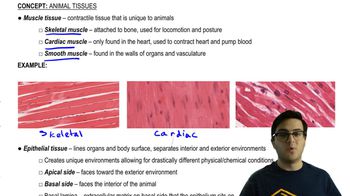
Types of muscle tissue and control
Skeletal muscle
is voluntary and striated;
cardiac muscle
is involuntary, striated, and branched;
smooth muscle
is involuntary and non-striated.
Features of skeletal muscle tissue
Long, multinucleated, striated fibers; under
voluntary control
; attached to bones.
Features of smooth muscle tissue
Spindle-shaped, single nucleus, no striations; under
involuntary control
; found in walls of hollow organs.
Features of cardiac muscle tissue
Branched, striated cells with single nucleus; connected by
intercalated disks
; involuntary control.
Structure and function of neurons
Cells with axons (carry signals away) and dendrites (receive signals); transmit electrical impulses for
communication
.
Role of myelin sheath and Schwann cells
Myelin sheath insulates axons;
Schwann cells
produce myelin in the peripheral nervous system.
 뒤로뒤로
 03:16