 뒤로
AP Biology Unit 1: Macromolecules and Their Components
 01:17

이 집합의 용어 (20)
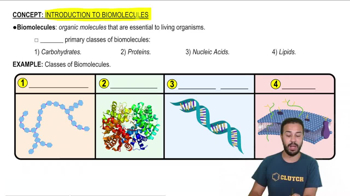
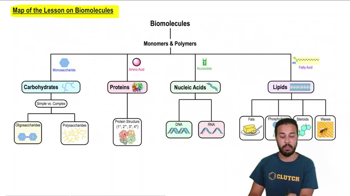
The four main types are carbohydrates, lipids, proteins, and nucleic acids.
Monosaccharides are the monomers of carbohydrates, such as glucose and fructose.
Monosaccharides generally have the formula \((CH_2O)_n\), where n is typically 3-7.
Sucrose (glucose + fructose) and lactose (glucose + galactose) are common disaccharides.
Starch stores energy in plants, and glycogen stores energy in animals.
Cellulose is a polysaccharide that provides structural support in plant cell walls.
Lipids are primarily composed of glycerol and fatty acids.
Saturated fatty acids have no double bonds; unsaturated fatty acids have one or more double bonds causing kinks.
A phospholipid has a hydrophilic phosphate head and two hydrophobic fatty acid tails.
Phospholipids form the bilayer of cell membranes, creating a selective barrier.
Amino acids are the monomers of proteins.
Primary (amino acid sequence), secondary (alpha helices and beta sheets), tertiary (3D folding), and quaternary (multiple polypeptide chains).
Peptide bonds link amino acids together in proteins.
Amino acids have an amino group (-NH2), a carboxyl group (-COOH), a hydrogen atom, and a variable R group.
Nucleic acids are polymers of nucleotides, each containing a sugar, phosphate group, and nitrogenous base.
DNA bases: adenine, thymine, cytosine, guanine. RNA bases: adenine, uracil, cytosine, guanine.
Phosphodiester bonds connect nucleotides between the phosphate of one and the sugar of the next.
DNA contains deoxyribose, RNA contains ribose sugar.
Carbohydrates also provide structural support and serve as cell recognition molecules.
Many proteins function as enzymes, catalyzing biochemical reactions.