 뒤로
Atomic Structure and Valence Shells
 02:13

이 집합의 용어 (20)
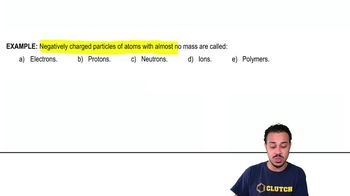
Atomic charge refers to the net electric charge of an atom, determined by the difference between the number of protons (positive) and electrons (negative).
Atomic mass is the total mass of protons and neutrons in an atom's nucleus, usually measured in atomic mass units (amu).
Protons and neutrons contribute to the atomic mass, while electrons have negligible mass.
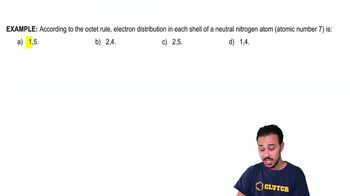
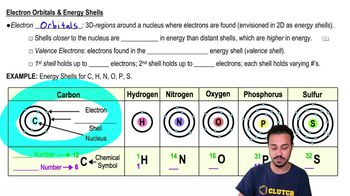
The valence shell is the outermost electron shell of an atom that determines its chemical properties and bonding behavior.
Valence electrons participate in chemical bonding and reactions, influencing an atom's reactivity.
The number of valence electrons corresponds to the electrons in the atom's outermost shell, often indicated by the group number in the periodic table.
A proton has a positive charge of +1.
An electron has a negative charge of -1.
A neutron has no electric charge; it is neutral.
Ions form when atoms gain or lose electrons, resulting in a net positive or negative charge.
Net atomic charge = number of protons - number of electrons, represented as \(Z - e\).
The number and arrangement of valence electrons determine an element's chemical behavior.
The first valence shell can hold up to 2 electrons.
The second valence shell can hold up to 8 electrons.
Atoms with a full valence shell are generally stable and less reactive.
An isotope is an atom of the same element with the same number of protons but different numbers of neutrons.
Atomic mass varies because isotopes have different numbers of neutrons, changing the total mass.
The atomic number is the number of protons in an atom's nucleus, defining the element.
Electrons fill shells starting from the innermost shell outward, following energy levels.
In a neutral atom, the number of electrons equals the atomic number, so the net charge is zero.