Skip to main content
General Biology
나의 코스
배우기
시험 준비
AI 튜터
학습 가이드
교과서적 해결책
플래시카드
탐험해 보세요
앱을 사용해 보세요
나의 코스
배우기
시험 준비
AI 튜터
학습 가이드
교과서적 해결책
플래시카드
탐험해 보세요
앱을 사용해 보세요
뒤로
Carbon and the Molecular Diversity of Life - General Biology
카드를 뒤집기 위해 탭할 수 있습니다.
What are the four emergent properties of water important for life?
카드를 뒤집기 위해 탭할 수 있습니다.
👆
What are the four emergent properties of water important for life?
Cohesion, moderation of temperature, expansion upon freezing, and solvent properties
.
진행 상황 추적
컨트롤 버튼이 '내비게이션' 모드로 변경되었습니다.
1/20
추천 영상
03:35
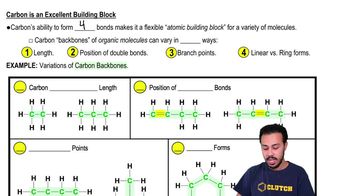
Carbon is an Excellent Building Block
22958
views
911
rank
04:19
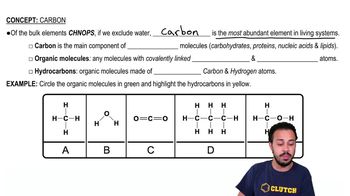
Carbon
30216
views
714
rank
2
comments
이 집합의 용어 (20)
하이드의 정의
What are the four emergent properties of water important for life?
Cohesion, moderation of temperature, expansion upon freezing, and solvent properties
.
Why is carbon the basis for all biological molecules?
Carbon can form
four covalent bonds
with a variety of atoms, allowing it to form diverse and complex molecules.
What is organic chemistry?
The study of compounds that contain
carbon
, regardless of their origin.
What did Stanley Miller's experiment demonstrate?
The abiotic synthesis of organic compounds, supporting the idea that life could have originated from non-living molecules.
What elements make up the major elements of life?
Carbon (C), Hydrogen (H), Oxygen (O), Nitrogen (N), Sulfur (S), and Phosphorus (P)
.
How does electron configuration affect carbon's bonding?
Carbon has
four valence electrons
, enabling it to form four covalent bonds with other atoms.
What shape do carbon atoms bonded to four other atoms form?
A
tetrahedral shape
.
What are hydrocarbons?
Organic molecules consisting only of
carbon and hydrogen
, often found in fats and can release large amounts of energy.
What are isomers?
Compounds with the same molecular formula but different
structures and properties
.
What are enantiomers and why are they important?
Isomers that are mirror images; important in pharmaceuticals because
different enantiomers can have different biological effects
.
What are functional groups?
Components of organic molecules most commonly involved in
chemical reactions
, giving molecules unique properties.
Name three functional groups important in life processes.
Hydroxyl (-OH), Carboxyl (-COOH), and Amino (-NH2)
.
What is ATP and why is it important?
Adenosine triphosphate (ATP) is an organic phosphate that stores potential energy used by cells when it reacts with water.
What happens when ATP reacts with water?
ATP converts to ADP and inorganic phosphate, releasing
energy
for cellular processes.
How do carbon skeletons vary?
They vary in
length, branching, double bond position, and presence of rings
.
What is the significance of carbon's ability to form four bonds?
It allows for the formation of
large, complex, and diverse organic molecules
essential for life.
What is the role of carbon chains in organic molecules?
They form the
skeletons
of most organic molecules, providing structure and diversity.
What is the difference between structural isomers and enantiomers?
Structural isomers differ in the
covalent arrangement
of atoms; enantiomers are mirror images differing in spatial arrangement.
Why are organisms sensitive to subtle variations in molecules?
Because even small changes like different enantiomers can lead to
different biological effects
.
What is the chemical basis for the diversity of organic molecules?
The versatility of
carbon's bonding
and the variety of functional groups attached to carbon skeletons.
 뒤로뒤로
 03:35