 뒤로
Cell Communication and Signal Transduction in General Biology
 05:03

이 집합의 용어 (21)
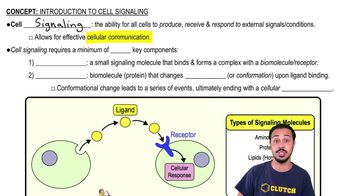
Signaling cell releases signaling molecules; responding cell has receptor proteins in membrane or cytosol that bind signaling molecules.
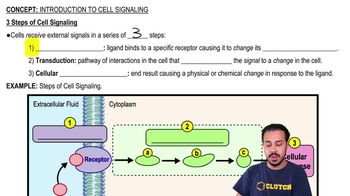
1. Receptor Activation (signal binds receptor)
2. Signal Transduction (signal transmitted inside cell)
3. Response (cell acts)
4. Termination (signal ends)
Signal diffuses to nearby cells; important in embryonic development and neurotransmission; signals growth, division, differentiation.
Cell produces a signal and also responds to its own signal.
Both cells have receptors that physically interlock to transmit signals.
Signals travel long distances through bloodstream to target cells with specific receptors; examples include adrenaline, testosterone, estrogen.
A receptor that specifically recognizes and binds a particular signaling molecule.
Information-carrying molecules secreted by cells, circulate in body, act on distant target cells; vary widely in chemical structure.
Steroid hormone receptors are inside the cell; most other signal receptors are in the plasma membrane.
Signaling molecules that bind only to cells with the correct (cognate) receptor.
Lipid-soluble steroid hormones bind receptors inside the cell and directly alter gene expression by hormone-receptor complex entering nucleus.
These hormones cannot cross the plasma membrane and rely on signal transduction pathways at the cell surface to relay and amplify the signal inside the cell.
Seven-transmembrane receptors that undergo conformational change when activated and trigger intracellular signaling via G proteins.
Inactive when bound to GDP; activated when receptor causes GDP to be exchanged for GTP; active G protein then activates enzymes producing second messengers.
Adenylyl cyclase converts ATP to cAMP, which activates protein kinase A to phosphorylate target proteins.
Activated G protein activates phospholipase C, producing IP3 which releases Ca2+ from SER; both IP3 and Ca2+ act as second messengers.
Enzyme-linked receptors that dimerize and autophosphorylate on tyrosine residues upon ligand binding, creating docking sites for signaling proteins.
Kinase adds phosphate groups to proteins (usually activating them); phosphatase removes phosphate groups (usually deactivating proteins).
RTK activation triggers Ras (a G protein) to activate a phosphorylation cascade of kinases, amplifying the signal and regulating gene expression for growth and division.
Signal molecule detaches from receptor, G protein hydrolyzes GTP to GDP, enzymes degrade cAMP, and phosphatases remove phosphate groups to stop signaling.
1. Change in gene expression
2. Activation or deactivation of existing target proteins in the cell.