Skip to main content
General Biology
나의 코스
배우기
시험 준비
AI 튜터
학습 가이드
교과서적 해결책
플래시카드
탐험해 보세요
앱을 사용해 보세요
나의 코스
배우기
시험 준비
AI 튜터
학습 가이드
교과서적 해결책
플래시카드
탐험해 보세요
앱을 사용해 보세요
뒤로
Cell Communication in General Biology
카드를 뒤집기 위해 탭할 수 있습니다.
What are the three main modes of cell communication?
카드를 뒤집기 위해 탭할 수 있습니다.
👆
What are the three main modes of cell communication?
Direct contact
,
local signaling
, and
endocrine (hormonal) signaling
.
진행 상황 추적
컨트롤 버튼이 '내비게이션' 모드로 변경되었습니다.
1/20
추천 영상
05:33
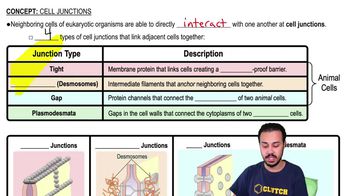
Cell Junctions
24066
views
304
rank
1
comments
이 집합의 용어 (20)
하이드의 정의
What are the three main modes of cell communication?
Direct contact
,
local signaling
, and
endocrine (hormonal) signaling
.
What are gap junctions and plasmodesmata?
Structures that allow direct exchange of molecules between adjacent cells in animals (gap junctions) and plants (plasmodesmata).
What is the general sequence of cell signaling?
Signal reception → signal transduction → cellular response.
How do lipid-soluble hormones signal cells?
They cross the membrane and bind to
intracellular receptors
.
How do lipid-insoluble hormones signal cells?
They bind to
cell-surface receptors
because they cannot cross the membrane.
What is signal amplification in cell communication?
One signaling molecule activates many downstream molecules, greatly increasing the cellular response.
Describe the role of G-protein coupled receptors (GPCRs) in signaling.
GPCRs activate G proteins, which then activate enzymes like adenylyl cyclase to produce second messengers.
What is a second messenger? Give an example.
A small, water-soluble molecule that diffuses rapidly inside cells to propagate signals; example:
cAMP
.
How does cAMP function in GPCR signaling?
cAMP activates protein kinase A (PKA), which triggers cellular responses such as glycogen breakdown.
What determines the specific cellular response to a hormone?
The type of receptor expressed and the cell's signaling pathways.
What are the two major types of cellular responses to signals?
1) Modification of existing proteins (rapid), 2) Changes in gene expression (slower).
How do receptor tyrosine kinases (RTKs) work?
Ligand binding causes dimerization and autophosphorylation, activating signaling pathways for cell growth and division.
What is the role of Ras in RTK signaling?
Ras is activated by RTKs and triggers a phosphorylation cascade to amplify the signal.
What is the function of kinases and phosphatases in signaling?
Kinases add phosphate groups to activate proteins; phosphatases remove them to deactivate proteins.
How do ligand-gated ion channels function in cell signaling?
Ligand binding opens the channel, allowing ions to flow and rapidly convert chemical signals into electrical responses.
Where are intracellular receptors located and what do they do?
In the cytoplasm or nucleus; they bind small or hydrophobic hormones and act as transcription factors.
What triggers apoptosis in cells?
External death signals or internal damage activate caspases that dismantle the cell safely.
Why is apoptosis important?
It removes damaged or infected cells, prevents tissue damage, and shapes development.
How do insulin and glucagon regulate blood glucose?
Insulin lowers blood glucose by promoting uptake and storage; glucagon raises glucose by stimulating release from the liver.
Why is signal termination important in hormonal signaling?
It prevents over-correction and maintains homeostasis by turning off signals when no longer needed.
 뒤로뒤로
 05:33
