 뒤로
Cell Cycle and Reproduction Vocabulary
 04:45

이 집합의 용어 (33)
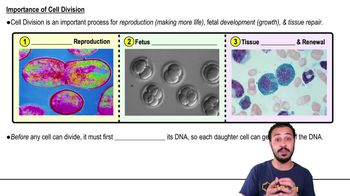
A covered series of growth and division a eukaryote cell goes through.
The first major phase of the eukaryote cell cycle.
The period during the cell cycle when DNA is replicated.
The third and final subphase of interphase.
The longest stage of the cell cycle.
A matched pair of chromosomes.
Where the cell divides.
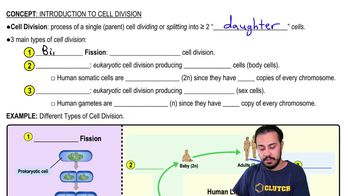
The physical process of cell division where the cytoplasm divides and nuclei separate.
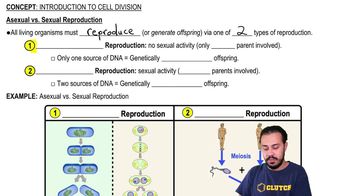
Reproduction without the involvement of sex cells.
The initial phase of mitosis where the cell prepares to divide.
The stage during mitosis when chromosomes line up in the middle of the cell.
When duplicated chromosomes separate and move to opposite poles.
The final stage of mitosis where the cell begins to split.
Structures that help separate chromosomes during mitosis.
A threadlike structure made of nucleic acids and protein carrying genetic information.
One of two identical halves of a duplicated chromosome.
Structure that forms during cytokinesis in plant cells to separate the two new cells.
The indentation that begins the process of cleavage in animal cells.
A group of diseases involving uncontrolled cell growth.
A mutated or overactive gene that has the potential to cause normal cells to become cancerous.
A biological process where two gametes fuse to form a new organism.
A type of cell division that reduces the chromosome number by half, producing four gamete cells.
Different forms of a gene located at the same position on homologous chromosomes.
The fusion of male and female gametes to form a zygote.
A sex cell, such as sperm or egg, that contains half the number of chromosomes.
A cell with one set of chromosomes (\(n\)).
A cell with two sets of chromosomes (\(2n\)).
A body cell containing a full set of chromosomes.
The first cell formed by the fusion of two gametes.
The exchange of genetic material between homologous chromosomes during meiosis.
Failure of chromosome pairs to separate properly during cell division.
The presence of three copies of a chromosome instead of two.
The presence of only one copy of a chromosome instead of two.