 뒤로
Cellular Respiration and ATP Production
 01:53

이 집합의 용어 (20)
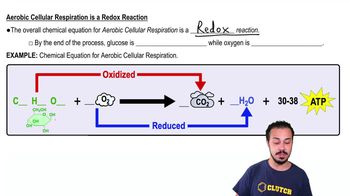
Cellular respiration is a catabolic pathway that converts organic molecules like glucose into usable energy in the form of ATP.
\(\mathrm{C_6H_{12}O_6 + 6O_2 \rightarrow 6CO_2 + 6H_2O + ATP + heat}\)
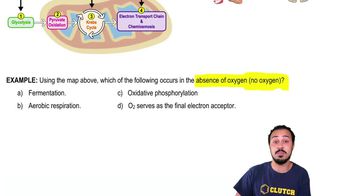
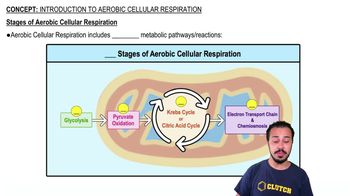
Glycolysis, Intermediate Step (Oxidation of Pyruvate), Citric Acid Cycle (Kreb's Cycle), Electron Transport Chain (Oxidative Phosphorylation).
Occurs in the cytoplasm; inputs: 1 glucose, 2 ATP, 2 NAD+; outputs: 2 pyruvate, 2 ATP, 2 NADH, 2 H2O.
Pyruvate is converted into Acetyl-CoA in the mitochondrial matrix, producing 1 NADH and 1 CO2 per pyruvate.
It oxidizes Acetyl-CoA to produce 3 NADH, 1 FADH2, 1 ATP, and 2 CO2 per cycle in the mitochondrial matrix.
Occurs in the inner mitochondrial membrane (cristae); it transfers electrons from NADH and FADH2 to oxygen, pumping H+ ions to create a gradient.
Exergonic diffusion of H+ ions through ATP synthase back into the matrix, driving ATP production.
It uses kinetic energy from H+ ions moving down their gradient to bind ADP and inorganic phosphate, forming ATP.
Direct enzymatic transfer of a phosphate group to ADP to form ATP during glycolysis and the Citric Acid Cycle.
Aerobic uses oxygen as the final electron acceptor; anaerobic does not and may use fermentation instead.
2 ATP, 2 lactate molecules, and heat from glucose breakdown without oxygen.
2 ATP, 2 ethanol molecules, 2 CO2, and heat from glucose breakdown without oxygen.
NAD+ acts as an electron carrier, accepting electrons during oxidation reactions to form NADH.
A chemical reaction involving the transfer of electrons where one molecule is oxidized and another is reduced.
Approximately 36 to 38 ATP molecules are produced per glucose molecule.
The electrochemical gradient of H+ ions across the mitochondrial membrane used to drive ATP synthesis.
Electrons combine with oxygen and H+ ions to form water.
They increase surface area for the Electron Transport Chain and ATP synthesis.
2 ATP molecules are produced per glucose molecule during glycolysis.