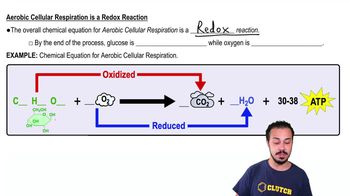
Cellular respiration is a metabolic pathway that extracts energy from organic molecules, primarily glucose, to produce ATP, the main energy currency of the cell.
Where does cellular respiration occur?
Cellular respiration occurs in the mitochondria of both plant and animal cells.
What are the key waste products of cellular respiration?
The key waste products are carbon dioxide (CO2) and water (H2O).
Define aerobic respiration.
Aerobic respiration consumes organic molecules and oxygen, producing ATP.
Define anaerobic respiration.
Anaerobic respiration uses compounds other than oxygen as the final electron acceptors in the electron transport chain.
What is fermentation?
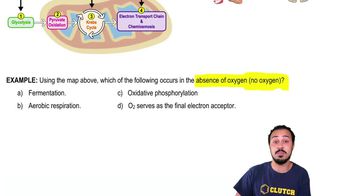
Fermentation is a partial degradation of sugars that occurs without oxygen, producing less ATP.
What are redox reactions in cellular respiration?
Redox reactions involve the transfer of electrons; oxidation is loss of electrons, and reduction is gain of electrons.
What roles do reducing and oxidizing agents play?
The reducing agent donates electrons, and the oxidizing agent accepts electrons.
How is glucose oxidized during cellular respiration?
Glucose is oxidized by transferring electrons to oxygen atoms, releasing energy for ATP synthesis.
What is the function of NAD+ in cellular respiration?
NAD+ is a coenzyme that acts as an electron carrier, becoming NADH when reduced.
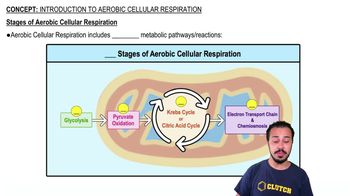
What are the three main stages of cellular respiration?
The stages are glycolysis, pyruvate oxidation and the citric acid cycle, and oxidative phosphorylation.
What happens during glycolysis?
Glycolysis breaks down glucose into two pyruvate molecules in the cytoplasm, producing a net of 2 ATP and 2 NADH.
Describe pyruvate oxidation.
Pyruvate is converted to acetyl CoA, releasing CO2 and reducing NAD+ to NADH.
What occurs in the citric acid cycle?
The citric acid cycle completes glucose oxidation, producing ATP, NADH, FADH2, and CO2.
What is oxidative phosphorylation?
Oxidative phosphorylation uses the electron transport chain and chemiosmosis to produce most ATP.
Explain chemiosmosis.
Chemiosmosis uses a proton gradient across the mitochondrial membrane to drive ATP synthesis via ATP synthase.
What is the proton-motive force?
The proton-motive force is the gradient of protons across the membrane used to do cellular work.
What is the approximate ATP yield per glucose molecule?
Cellular respiration produces about 30–32 ATP per glucose molecule.
How do fermentation and anaerobic respiration differ from aerobic respiration?
Fermentation uses organic molecules as electron acceptors and produces 2 ATP; anaerobic respiration uses other electron acceptors; aerobic respiration uses oxygen and produces up to 32 ATP.
What is the evolutionary significance of glycolysis?
Glycolysis is the most widespread metabolic pathway, used by early prokaryotes before oxygen was present.
How is cellular respiration regulated?
Cellular respiration is regulated by feedback inhibition; high ATP levels slow respiration, low ATP levels speed it up.
 뒤로
 01:53