Skip to main content
General Biology
나의 코스
배우기
시험 준비
AI 튜터
학습 가이드
교과서적 해결책
플래시카드
탐험해 보세요
앱을 사용해 보세요
나의 코스
배우기
시험 준비
AI 튜터
학습 가이드
교과서적 해결책
플래시카드
탐험해 보세요
앱을 사용해 보세요
뒤로
Cellular Respiration Overview - General Biology
카드를 뒤집기 위해 탭할 수 있습니다.
What are the starting and ending molecules of cellular respiration?
카드를 뒤집기 위해 탭할 수 있습니다.
👆
What are the starting and ending molecules of cellular respiration?
Cellular respiration starts with
glucose and oxygen
and ends with
water (H2O), carbon dioxide (CO2), and energy
.
진행 상황 추적
컨트롤 버튼이 '내비게이션' 모드로 변경되었습니다.
1/10
추천 영상
01:53
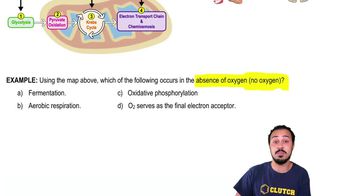
Introduction to Cellular Respiration Example 2
20099
views
234
rank
04:18
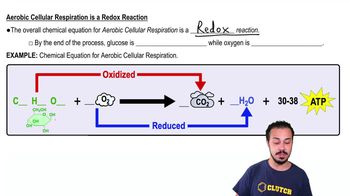
Aerobic Cellular Respiration is a Redox Reaction
31115
views
475
rank
02:31
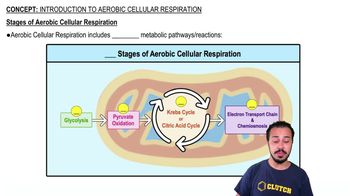
Stages of Aerobic Cellular Respiration
23738
views
361
rank
1
comments
이 집합의 용어 (10)
하이드의 정의
What are the starting and ending molecules of cellular respiration?
Cellular respiration starts with
glucose and oxygen
and ends with
water (H2O), carbon dioxide (CO2), and energy
.
What is the main purpose of glycolysis in cellular respiration?
Glycolysis converts sugar into
pyruvate, energy, water
, and electron carriers
NADH
.
What are the products of pyruvate oxidation?
Pyruvate oxidation produces
enzyme CoA, NADH, and CO2
, and this happens twice per glucose molecule.
What happens during the citric acid cycle?
The citric acid cycle uses enzymes and ADP to produce
CO2, electrons for NADH and FADH2, and two ATP molecules
.
What is the role of oxidative phosphorylation in cellular respiration?
Oxidative phosphorylation uses the
electron transport chain (ETC), proton motive force, and ATP synthase
to produce
32 ATP
.
How many ATP molecules are produced in total by cellular respiration?
Cellular respiration produces a total of
32 ATP molecules
.
Which stage of cellular respiration produces water as a product?
Water is produced during
oxidative phosphorylation
when oxygen accepts electrons.
What electron carriers are generated during glycolysis and the citric acid cycle?
Electron carriers
NADH
are produced in glycolysis and both
NADH and FADH2
are produced in the citric acid cycle.
How many times does pyruvate oxidation occur per glucose molecule?
Pyruvate oxidation occurs
two times
per glucose molecule because glucose splits into two pyruvate molecules.
What is the function of Coenzyme A (CoA) in cellular respiration?
Coenzyme A binds to pyruvate during
pyruvate oxidation
to form acetyl-CoA, which enters the citric acid cycle.
 뒤로뒤로
 01:53