 뒤로
Ch. 10
 04:14

이 집합의 용어 (26)
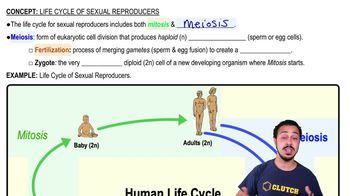
The sexual life cycle includes meiosis, gamete formation, fertilization, and mitosis, cycling between diploid and haploid stages.
Germ cells are specialized diploid cells that undergo meiosis to produce haploid gametes.
Gametes are produced by meiosis from germ cells, reducing chromosome number by half.
Mitosis produces somatic cells and allows growth and development from the zygote.
Fertilization fuses two haploid gametes, restoring the diploid chromosome number in the zygote.
Haploid (n) cells have one set of chromosomes; diploid (2n) cells have two sets.
Crossing over is the exchange of genetic material between non-sister chromatids during Prophase I of meiosis.
Crossing over occurs between homologous chromosomes, specifically between their non-sister chromatids.
Independent assortment is the random orientation of homologous chromosome pairs during Metaphase I, increasing genetic variation.
It creates new combinations of maternal and paternal chromosomes in gametes.
Random fertilization is the unpredictable fusion of any sperm with any egg, further increasing genetic diversity.
Because of crossing over, independent assortment, and random fertilization, siblings inherit unique genetic combinations.
Chromosome number is halved; cells become haploid but chromosomes still have sister chromatids.
In Anaphase I, homologous chromosomes separate; in Anaphase II, sister chromatids separate.
Due to crossing over and independent assortment, each gamete has a unique genetic makeup.
Mitosis produces two identical diploid cells; meiosis produces four genetically diverse haploid cells with two divisions.
To separate homologous chromosomes first, then sister chromatids, halving chromosome number.
Independent assortment occurs during Metaphase I of meiosis.
Mitosis does not involve pairing of homologous chromosomes, so crossing over does not occur.
Nondisjunction is the failure of chromosomes to separate properly during meiosis, leading to abnormal chromosome numbers.
Nondisjunction can occur during Anaphase I or Anaphase II of meiosis.
Meiosis I nondisjunction affects homologous chromosomes; Meiosis II affects sister chromatids, resulting in different gamete abnormalities.
Older eggs have prolonged arrest in meiosis, increasing errors in chromosome separation.
The zygote will have 47 chromosomes, causing trisomy.
Trisomy 21 is more viable and compatible with life compared to other trisomies.
Includes informed consent, privacy, potential discrimination, and decisions about pregnancy continuation.