뒤로

Ch. 9

컨트롤 버튼이 '내비게이션' 모드로 변경되었습니다.
1/28
  • Why is cell division necessary?

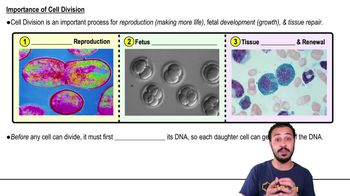
    Cell division is necessary for growth, repair of damaged tissues, and asexual reproduction.
  • Define genome, chromosomes, chromatin, somatic cells, and gametes.

    Genome: complete set of genetic material.
    Chromosomes: DNA molecules with genes.
    Chromatin: DNA-protein complex in nucleus.
    Somatic cells: body cells, diploid.
    Gametes: sex cells, haploid.
  • What are homologous chromosomes?

    Homologous chromosomes are pairs of chromosomes, one from each parent, that have the same genes but may have different alleles.
  • What are sister chromatids?

    Sister chromatids are identical copies of a chromosome connected at the centromere formed after DNA replication.
  • Describe the phases of the cell cycle.

    G1: cell growth.
    S phase: DNA synthesis.
    G2: preparation for mitosis.
    M phase: mitosis and cytokinesis.
  • What happens during prophase?

    Chromosomes condense, spindle fibers form, and the nuclear envelope breaks down.
  • What occurs in metaphase?

    Chromosomes align at the cell's equator, attached to spindle fibers at kinetochores.
  • Describe anaphase.

    Sister chromatids separate and move toward opposite poles of the cell.
  • What happens during telophase?

    Chromosomes decondense, nuclear envelopes reform, and the cell prepares to divide.
  • What is cytokinesis?

    Division of the cytoplasm resulting in two daughter cells.
  • What are cell cycle checkpoints?

    Control points (G1/S, G2/M, spindle) that ensure proper division and DNA integrity.
  • Difference between tumor suppressor genes and oncogenes?

    Tumor suppressor genes prevent uncontrolled growth; mutations inactivate them.
    Oncogenes promote growth; mutations activate them.
  • How many copies of tumor suppressor genes need mutation to cause cancer?

    Both copies must be mutated to lose function and contribute to cancer.
  • How many copies of proto-oncogenes need mutation to cause cancer?

    A mutation in one copy can activate it to an oncogene causing cancer.
  • Role of Ras protein in cell division?

    Ras transmits growth signals; a malfunctioning Ras causes continuous cell division leading to cancer.
  • How does Herceptin work in breast cancer therapy?

    Herceptin binds HER2 receptors, blocking their signaling and inhibiting cancer cell growth.
  • What is the function of p53 in the cell cycle?

    p53 detects DNA damage and can halt the cycle or trigger apoptosis to prevent cancer.
  • How does a p53 mutation affect cancer cells?

    Mutated p53 fails to stop damaged cells, allowing uncontrolled division and tumor growth.
  • How do microtubules and actin filaments contribute to cell division?

    Microtubules form the spindle for chromosome movement; actin filaments help in cytokinesis.
  • Why do drugs targeting microtubules and actin inhibit cancer cell division?

    They disrupt spindle formation or cytokinesis, blocking cell division and tumor growth.
  • Which phase is most affected by doxorubicin chemotherapy?

    Doxorubicin targets the S phase by intercalating DNA and inhibiting DNA synthesis.
  • Explain the G1 checkpoint in the cell cycle.

    Checks for DNA damage and growth signals before DNA replication.
  • Explain the G2 checkpoint in the cell cycle.

    Ensures DNA replication is complete and checks for DNA damage before mitosis.
  • Explain the M checkpoint in the cell cycle.

    Checks proper spindle attachment to chromosomes before anaphase.
  • What is the significance of Ki-67 in cancer?

    Ki-67 is a proliferation marker; high levels indicate rapid cell division.
  • How does radiation therapy inhibit tumor growth?

    Radiation damages DNA, activating p53 to stop division or induce apoptosis.
  • What is the effect of a Ras mutation that cannot be inactivated?

    Leads to continuous activation of the growth pathway and uncontrolled cell division.
  • Why might Tamoxifen increase bone density despite blocking estrogen receptors?

    Tamoxifen acts as an estrogen agonist in bone tissue, promoting bone density.