Skip to main content
General Biology
나의 코스
배우기
시험 준비
AI 튜터
학습 가이드
교과서적 해결책
플래시카드
탐험해 보세요
앱을 사용해 보세요
나의 코스
배우기
시험 준비
AI 튜터
학습 가이드
교과서적 해결책
플래시카드
탐험해 보세요
앱을 사용해 보세요
뒤로
Ch.5 Cell Membrane Structure & Transport Processes
카드를 뒤집기 위해 탭할 수 있습니다.
Phospholipid structure
카드를 뒤집기 위해 탭할 수 있습니다.
👆
Phospholipid structure
Phospholipids have a hydrophilic phosphate head and two hydrophobic fatty acid tails, forming the basic structure of cell membranes.
진행 상황 추적
컨트롤 버튼이 '내비게이션' 모드로 변경되었습니다.
1/21
추천 영상
02:21
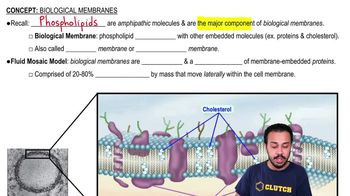
Biological Membranes Example 1
24641
views
457
rank
1
comments
06:04
Biological Membranes
33779
views
685
rank
2
comments
이 집합의 용어 (21)
하이드의 정의
Phospholipid structure
Phospholipids have a hydrophilic phosphate head and two hydrophobic fatty acid tails, forming the basic structure of cell membranes.
Phospholipid bilayer
Cell membranes consist of a phospholipid bilayer with hydrophilic heads facing outward and hydrophobic tails facing inward.
Fluid mosaic model
Describes the plasma membrane as a fluid combination of phospholipids, cholesterol, and proteins that move laterally.
Integral membrane proteins
Proteins embedded within the membrane with hydrophilic and hydrophobic regions, often forming channels or carriers.
Peripheral membrane proteins
Proteins attached to the membrane surface, not embedded, often involved in signaling or structural support.
Cholesterol role in membranes
Cholesterol in animal membranes provides flexibility and stability by preventing tight packing of phospholipids.
Selective permeability
The plasma membrane allows some molecules to pass while blocking others based on size, charge, and polarity.
Diffusion
Passive movement of molecules from high to low concentration without energy input.
Osmosis
The diffusion of water across a selectively permeable membrane from low to high solute concentration.
Isotonic solution
A solution with equal solute concentration compared to the cell, causing no net water movement.
Hypertonic solution
A solution with higher solute concentration than the cell, causing water to leave the cell and shrink.
Hypotonic solution
A solution with lower solute concentration than the cell, causing water to enter the cell and swell.
Facilitated diffusion
Passive transport of polar or charged molecules across membranes via specific transport proteins.
Active transport
Energy-requiring process where molecules move against their concentration gradient using transport proteins and ATP.
Exocytosis
Process where cells export large molecules by vesicles fusing with the plasma membrane.
Endocytosis
Process where cells engulf large molecules by forming vesicles from the plasma membrane.
Phagocytosis
A type of endocytosis where the cell engulfs large particles or cells ('cell eating').
Receptor-mediated endocytosis
Selective uptake of molecules using receptors on the cell surface that trigger vesicle formation.
Concentration gradient
Difference in molecule concentration across a space or membrane driving diffusion.
Role of transport proteins
Transport proteins assist in moving substances that cannot diffuse freely through the lipid bilayer.
Effect of tonicity on plant cells
In hypotonic solutions, plant cells become turgid; in hypertonic, they plasmolyze; isotonic causes flaccidity.
 뒤로뒤로
 02:21