Skip to main content
General Biology
나의 코스
배우기
시험 준비
AI 튜터
학습 가이드
교과서적 해결책
플래시카드
탐험해 보세요
앱을 사용해 보세요
나의 코스
배우기
시험 준비
AI 튜터
학습 가이드
교과서적 해결책
플래시카드
탐험해 보세요
앱을 사용해 보세요
뒤로
Chapter 2 lecture 3
카드를 뒤집기 위해 탭할 수 있습니다.
What type of bond exists between oxygen and hydrogen within a water molecule?
카드를 뒤집기 위해 탭할 수 있습니다.
👆
What type of bond exists between oxygen and hydrogen within a water molecule?
A
polar covalent bond
exists between oxygen and hydrogen within a water molecule.
진행 상황 추적
컨트롤 버튼이 '내비게이션' 모드로 변경되었습니다.
1/23
추천 영상
05:03
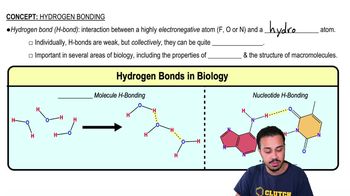
Hydrogen Bonding
23601
views
383
rank
1
comments
이 집합의 용어 (23)
하이드의 정의
What type of bond exists between oxygen and hydrogen within a water molecule?
A
polar covalent bond
exists between oxygen and hydrogen within a water molecule.
What type of bond links water molecules together?
Hydrogen bonds
link water molecules together.
Define cohesion in the context of water molecules.
Cohesion
is the linking together of like molecules, often by hydrogen bonds.
What is surface tension in water?
Surface tension
is a measure of how difficult it is to stretch or break the surface of a liquid.
Define adhesion related to water molecules.
Adhesion
is the clinging of one substance to another, often by hydrogen bonds.
What is thermal energy in relation to atoms and molecules?
Thermal energy
is the total energy associated with the random movement of atoms and molecules.
How is temperature defined in terms of molecular energy?
Temperature
is the average energy of the molecules of a body of matter, regardless of volume.
Explain why water requires a lot of energy to change temperature.
Water requires a lot of energy to change temperature because heat is used to disrupt hydrogen bonds before speeding up molecules.
What is evaporative cooling?
Evaporative cooling
occurs when the hottest molecules escape from a liquid into gas, leaving behind a cooler liquid.
Why does ice float on liquid water?
Ice floats because hydrogen bonds in ice are stable and form a less dense structure than liquid water, where bonds constantly break and reform.
What would happen if ice sank in bodies of water?
If ice sank, bodies of water would freeze solid, disrupting ecosystems.
Define a solution in chemistry.
A
solution
is a liquid that is a homogeneous mixture of two or more substances.
What is the solvent in saltwater?
In saltwater,
water
is the solvent.
What is the solute in saltwater?
In saltwater,
salt (NaCl)
is the solute.
Define hydrophilic substances.
Hydrophilic
substances have an affinity for water and are typically ionic or polar.
Define hydrophobic substances.
Hydrophobic
substances repel water and are typically nonionic and nonpolar.
What is an acid in terms of H+ concentration?
An
acid
is a substance that increases the concentration of H+ ions in water.
What is a base in terms of H+ concentration?
A
base
is a substance that reduces the concentration of H+ ions in water.
What is the role of buffers in aqueous solutions?
Buffers
minimize changes in concentrations of H+ and OH- ions, maintaining pH stability.
What does a pH of 7 represent?
A pH of 7 is
neutral
, meaning equal concentrations of H+ and OH- ions.
How much more acidic is a solution with pH 5 compared to pH 7?
A solution with pH 5 is
100 times more acidic
than a solution with pH 7, due to the logarithmic scale.
Is a solution with pH 5 acidic or basic?
A solution with pH 5 is
acidic
.
Does a solution with pH 11 or pH 13 have more H+ ions?
A solution with pH 11 has more H+ ions than one with pH 13, since higher pH means fewer H+ ions.
 뒤로뒤로
 05:03
