 뒤로
chapter 26
 02:32

이 집합의 용어 (22)
Phylogeny is the evolutionary history of a species or group of related species.
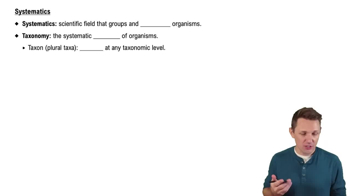
Systematics is the discipline focused on classifying organisms and determining their evolutionary relationships.
A taxon is a group at any level of the taxonomic hierarchy, such as domain, kingdom, phylum, class, order, family, genus, or species.
A phylogenetic tree is a branching diagram representing the evolutionary history of a group of organisms, showing hypotheses about their relationships.
Sister taxa are groups that share a common ancestor not shared by any other group.
A basal taxon is a lineage that diverges early from all other members of the group in evolutionary history.
Homology refers to phenotypic and genetic similarities due to shared ancestry, indicating close evolutionary relationships.
Analogy is similarity due to convergent evolution, where unrelated species evolve similar traits independently.
Convergent evolution is the process where unrelated species evolve similar traits in response to similar environmental pressures.
Cladistics is a classification method grouping organisms by common ancestry using shared derived characters.
A clade is a group including an ancestral species and all its descendants; clades can be nested within larger clades.
A monophyletic group consists of an ancestor and all its descendants; it is a true clade.
A paraphyletic group includes an ancestor and some, but not all, of its descendants; it is not a valid clade.
A polyphyletic group includes distantly related species but not their most recent common ancestor; it is not a valid clade.
A shared ancestral character is a trait that originated in an ancestor of the taxon being studied and is shared with the outgroup.
A shared derived character is an evolutionary novelty unique to a particular clade, including lost or new features.
The outgroup is a species or group closely related to but outside the group being studied, used to identify shared derived characters.
The ingroup is the group of species being studied and compared with the outgroup.
Maximum parsimony states the most likely phylogenetic tree requires the fewest evolutionary changes.
Maximum likelihood identifies the tree most likely to produce observed DNA data based on probability rules of DNA change.
The molecular clock estimates absolute evolutionary time by assuming some genes evolve at a constant rate, calibrated with fossil data.
Horizontal gene transfer is the movement of genes between genomes by means other than vertical inheritance, important in prokaryote and eukaryote evolution.