Skip to main content
General Biology
나의 코스
배우기
시험 준비
AI 튜터
학습 가이드
교과서적 해결책
플래시카드
탐험해 보세요
앱을 사용해 보세요
나의 코스
배우기
시험 준비
AI 튜터
학습 가이드
교과서적 해결책
플래시카드
탐험해 보세요
앱을 사용해 보세요
뒤로
Chapter 3 lecture 1
카드를 뒤집기 위해 탭할 수 있습니다.
How many covalent bonds can a carbon atom form?
카드를 뒤집기 위해 탭할 수 있습니다.
👆
How many covalent bonds can a carbon atom form?
Carbon
can form
four covalent bonds
due to its four valence electrons.
진행 상황 추적
컨트롤 버튼이 '내비게이션' 모드로 변경되었습니다.
1/20
추천 영상
03:35
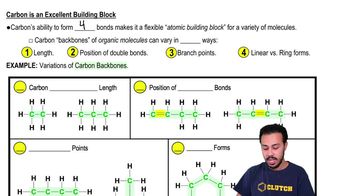
Carbon is an Excellent Building Block
22917
views
910
rank
04:19
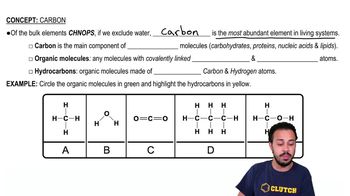
Carbon
30161
views
713
rank
2
comments
이 집합의 용어 (20)
하이드의 정의
How many covalent bonds can a carbon atom form?
Carbon
can form
four covalent bonds
due to its four valence electrons.
What are hydrocarbons?
Organic molecules consisting only of
carbon and hydrogen
atoms.
What is a polymer?
A
long molecule
made of many similar or identical building blocks called
monomers
joined by covalent bonds.
What is dehydration synthesis?
A chemical reaction where two molecules are covalently joined with the
removal of a water molecule
.
What is hydrolysis?
A reaction that
breaks bonds
between molecules by the
addition of water
.
What is a monosaccharide?
The
monomer
of carbohydrates, typically a multiple of the unit
CH2O
, such as glucose (C6H12O6).
What functional groups are present in monosaccharides?
Monosaccharides contain a
carbonyl group
and several
hydroxyl groups
.
What is a disaccharide?
Two monosaccharides joined by a
glycosidic linkage
formed by a dehydration reaction.
What is a polysaccharide?
Carbohydrate polymers made of hundreds to thousands of monosaccharides joined by glycosidic linkages.
What are the main functions of polysaccharides?
Polysaccharides serve as
energy storage
and
structural support
in cells.
How are polysaccharides broken down into monosaccharides?
By
hydrolysis
, which breaks glycosidic bonds with the addition of water.
What is the difference between glucose and fructose structures?
Glucose has a
carbonyl group at the end
(aldehyde), fructose has it
within the chain
(ketone).
What is a glycosidic linkage?
A
covalent bond
formed between two monosaccharides by dehydration synthesis.
What is the structure of methane (CH4)?
A carbon atom bonded to four hydrogen atoms in a
tetrahedral shape
.
What are the types of carbon skeleton variations?
Length variation, double bonds, branching, and ring formation.
Name important chemical groups in organic compounds.
Hydroxyl, carbonyl, carboxyl, amino, phosphate, and methyl groups.
What is the role of the amino group in organic molecules?
Acts as a base and can pick up a proton, found in amino acids.
What is the function of the phosphate group?
Contributes negative charge and is involved in energy transfer (e.g., ATP).
What is the methyl group important for?
Affects gene expression and molecular shape, often involved in methylated compounds.
What is the difference between starch, glycogen, and cellulose?
Starch and glycogen are energy storage polysaccharides; cellulose provides structural support in plant cell walls.
 뒤로뒤로
 03:35