Skip to main content
General Biology
나의 코스
배우기
시험 준비
AI 튜터
학습 가이드
교과서적 해결책
플래시카드
탐험해 보세요
앱을 사용해 보세요
나의 코스
배우기
시험 준비
AI 튜터
학습 가이드
교과서적 해결책
플래시카드
탐험해 보세요
앱을 사용해 보세요
뒤로
Chapter 5
카드를 뒤집기 위해 탭할 수 있습니다.
Amphipathic molecule
카드를 뒤집기 위해 탭할 수 있습니다.
👆
Amphipathic molecule
A molecule with both
hydrophilic
(water-loving) and
hydrophobic
(water-fearing) parts.
진행 상황 추적
컨트롤 버튼이 '내비게이션' 모드로 변경되었습니다.
1/22
추천 영상
02:21
Biological Membranes Example 1
24641
views
457
rank
1
comments
06:04
Biological Membranes
33779
views
685
rank
2
comments
이 집합의 용어 (22)
하이드의 정의
Amphipathic molecule
A molecule with both
hydrophilic
(water-loving) and
hydrophobic
(water-fearing) parts.
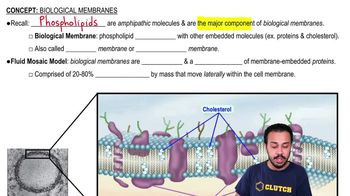
Primary component of biological membranes
Phospholipids
form the main structure of biological membranes.
Phospholipid bilayer
A
double layer
of phospholipids that makes up plasma and organelle membranes.
Fluid mosaic model
Describes membranes as a
dynamic structure
where molecules move laterally, creating a fluid-like nature.
Protein content in biological membranes
Biological membranes can be made up of
20-80%
proteins.
Selective permeability
The membrane's ability to
regulate passage
of substances in and out of the cell.
Role of cholesterol in membranes
Cholesterol helps to
stabilize membrane fluidity
.
Embedded proteins
Proteins inserted into the phospholipid bilayer that can move laterally and perform various functions.
Other terms for biological membranes
Also called
cell membranes
or
plasma membranes
.
Hydrophilic
Water-loving; refers to the
polar head
of a phospholipid.
Hydrophobic
Water-fearing; refers to the
non-polar tail
of a phospholipid.
Meaning of 'bi' in bilayer
Means
two
, indicating two layers of phospholipids.
Mosaic in fluid mosaic model
Refers to the membrane being made of many different parts like proteins and lipids.
Function of biological membranes
To
control passage
of molecules into and out of the cell, like the skin of the body.
Carbohydrate groups in membranes
Attached to proteins and lipids; involved in
cell recognition and signaling
.
What allows membrane fluidity?
The
lateral movement
of phospholipids and proteins within the bilayer.
Significance of amphipathic phospholipids
Allows formation of bilayers with hydrophilic heads outward and hydrophobic tails inward.
Cholesterol in animal cell membranes
A lipid interspersed in the bilayer that contributes to
membrane fluidity
.
Main function of embedded proteins
Perform
transport, signaling,
and
structural support
roles.
Semi-fluid nature of membranes
Membranes are not fixed; molecules can
move around
within the bilayer.
Implication of fluid mosaic model
Membranes are composed of various molecules that
move and shift
, creating a flexible structure.
Role of carbohydrate groups on membrane proteins and lipids
Involved in
cell recognition
and
signaling
.
 뒤로뒤로
 02:21