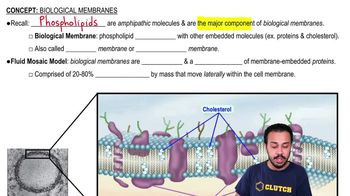
Describes the plasma membrane as a dynamic structure with proteins and lipids forming specialized patches that move laterally within the phospholipid bilayer.
Phospholipid bilayer structure
Composed of amphipathic phospholipids with hydrophilic heads facing water and hydrophobic tails shielded inside, forming a stable boundary between aqueous compartments.
Membrane fluidity factors
Unsaturated hydrocarbon tails increase fluidity by preventing tight packing; cholesterol stabilizes fluidity by restraining movement at high temperatures and preventing solidification at low temperatures.
Integral vs. peripheral membrane proteins
Integral proteins span the lipid bilayer and often form hydrophilic channels; peripheral proteins are loosely attached to membrane surfaces, often on the cytoplasmic side.
Selective permeability of membranes
Membranes allow some substances to cross more easily than others, with hydrophobic molecules passing rapidly and ions or polar molecules requiring transport proteins.
Passive transport
Diffusion of substances down their concentration gradient across membranes without energy input, including simple diffusion and facilitated diffusion via transport proteins.
Facilitated diffusion
Passive transport aided by channel or carrier proteins that allow specific polar molecules or ions to cross membranes faster than by diffusion alone.
Active transport
Energy-requiring process where transport proteins move solutes against their concentration gradients, often powered by ATP hydrolysis.
Sodium-potassium pump cycle
Moves 3 Na+ ions out and 2 K+ ions in per cycle using ATP; involves binding, phosphorylation, conformational change, ion release, and dephosphorylation.
Osmosis
Diffusion of free water across a selectively permeable membrane from higher free water concentration (lower solute) to lower free water concentration (higher solute).
Tonicity effects on cells
Isotonic: no net water movement; hypotonic: water enters cell causing swelling; hypertonic: water leaves cell causing shrinkage or plasmolysis.
Bulk transport mechanisms
Exocytosis secretes large molecules via vesicle fusion with plasma membrane; endocytosis takes in large molecules by vesicle formation (phagocytosis, pinocytosis, receptor-mediated).
G protein-coupled receptors (GPCRs)
Transmembrane receptors that activate G proteins upon ligand binding, triggering intracellular signaling cascades.
Ligand-gated ion channels
Membrane receptors that open or close ion channels in response to ligand binding, altering ion flow and cellular activity.
Intracellular receptors
Receptors located in cytoplasm or nucleus that bind hydrophobic signaling molecules able to cross the membrane, often acting as transcription factors.
Phosphorylation cascade
Series of protein kinases activating each other by phosphorylation, amplifying the signal and regulating cellular responses.
Second messengers
Small nonprotein molecules like cyclic AMP (cAMP) that diffuse within the cell to propagate and amplify signals.
Cotransport
Transport protein couples downhill diffusion of one solute to uphill transport of another, using energy stored in electrochemical gradients.
Membrane potential
Voltage across the plasma membrane caused by unequal ion distribution, influencing ion movement and cellular processes.
Role of cholesterol in membranes
Cholesterol modulates membrane fluidity by restraining phospholipid movement at high temperatures and preventing tight packing at low temperatures.
Aquaporins
Channel proteins that facilitate rapid water transport across membranes, excluding charged ions like hydronium.
Cells recognize each other via membrane carbohydrates attached to glycoproteins and glycolipids, important for immune response and development.
Membrane synthesis and sidedness
Membrane proteins and lipids are synthesized in the ER and Golgi, establishing asymmetric distribution of molecules between inner and outer membrane faces.
Signal transduction stages
Reception: ligand binds receptor; transduction: signal relayed and amplified; response: cellular activity changes such as gene expression or enzyme activation.
Role of protein kinases and phosphatases
Protein kinases add phosphate groups to activate proteins; phosphatases remove them to deactivate proteins, regulating signaling pathways.
Membrane protein functions
Include transport, enzymatic activity, signal transduction, cell-cell recognition, intercellular joining, and attachment to cytoskeleton and ECM.
Electrogenic pumps
Membrane proteins like sodium-potassium and proton pumps that generate voltage by moving ions, storing energy for cellular work.
Receptor-mediated endocytosis example
Cells take in cholesterol via LDL receptors; defects cause familial hypercholesterolemia with high blood cholesterol.
 뒤로
 02:21